My child isn't talking yet. Could it be autism?
This is one of the most common and emotionally overwhelming questions parents ask when their child isn't meeting speech and language milestones. While a delay in talking can sometimes be an early sign of Autism Spectrum Disorder (ASD), not every child with a speech delay has autism. In fact, many children experience speech delays for reasons completely unrelated to autism, such as hearing difficulties, developmental language disorders, oral-motor challenges, or simply being "late talkers."
The confusion arises because both speech delay and autism can affect communication, especially during the first few years of life. A toddler who isn't speaking may appear similar to another child with autism at first glance. However, when professionals evaluate a child, they look beyond spoken words. They assess how the child communicates through gestures, responds to their name, makes eye contact, shares interests, plays with others, and interacts socially. These developmental patterns often provide clearer clues than speech alone.
Understanding the difference is important because speech delay and autism are not the same condition, and each requires a different approach to assessment, intervention, and long-term support. Early recognition also allows families to access the right therapies during the years when a child's brain is most adaptable to learning and development.
In this article, we'll explain the key differences between speech delay and autism, compare their signs and symptoms, discuss developmental milestones, explore when to seek professional help, and answer the questions parents ask most often.
Understanding Speech Delay
Speech and language development is one of the most exciting milestones during early childhood. A baby's first sounds gradually develop into words, sentences, conversations, and eventually meaningful communication. While every child develops at their own pace, there are expected milestones that most children achieve within a predictable age range.
When a child develops speech and language skills significantly later than expected for their age, healthcare professionals describe it as a speech or language delay.
Simply put, a speech delay means a child has difficulty producing speech sounds or using spoken words compared with peers of the same age. Some children understand everything they hear but struggle to express themselves verbally, while others may also have difficulty understanding language.
Speech delay is not a diagnosis in itself. Instead, it is a symptom that can occur for many different reasons. Some children are simply late talkers and catch up naturally, while others may require speech-language therapy to build communication skills.
Speech delays are generally classified into three categories.
Expressive Language Delay
Children with expressive language delay understand much of what is said to them but have difficulty expressing themselves using words or sentences.
They may:
- Use fewer words than expected
- Speak in short phrases
- Have difficulty forming sentences
- Become frustrated because they cannot communicate effectively
These children often follow instructions well and appear socially engaged despite limited speech.
Receptive Language Delay
Receptive language refers to understanding spoken language.
Children with receptive language delays may struggle to:
- Understand simple instructions
- Identify familiar objects
- Follow conversations
- Process spoken information
Because understanding language is affected, communication challenges are often more noticeable than with expressive delays alone.
Mixed Receptive-Expressive Language Delay
Some children experience difficulties both understanding language and expressing themselves.
These children may:
- Have limited vocabulary
- Find it difficult to follow directions
- Use fewer gestures
- Experience frustration during communication
This type of delay often requires comprehensive evaluation and individualized intervention.
What Causes Speech Delay?

Speech delay does not have a single cause. Instead, several medical, developmental, and environmental factors can influence language development.
Common causes include:
Hearing Loss
Children learn speech by listening to the people around them. Temporary hearing problems caused by recurrent ear infections or permanent hearing loss may reduce access to spoken language during critical developmental periods.
Oral-Motor Difficulties
Speech requires precise coordination of the lips, tongue, jaw, palate, and breathing muscles. Weakness or difficulty coordinating these muscles can make speech production challenging.
Developmental Language Disorder (DLD)
Some children experience persistent language difficulties despite having normal intelligence, hearing, and opportunities to learn language. This condition is known as Developmental Language Disorder.
Childhood Apraxia of Speech
In childhood apraxia, the brain has difficulty planning and coordinating the movements required for speech, even though the muscles themselves are normal.
Premature Birth or Neurological Conditions
Prematurity, certain neurological disorders, and brain injuries can influence speech and language development.
Environmental Factors
Children learn language through daily interaction.
Limited opportunities for conversation, excessive passive screen time, reduced parent-child interaction, or psychosocial adversity may contribute to delayed language development, although they are rarely the sole cause.
Late Talkers
Some toddlers begin speaking later than their peers but eventually develop age-appropriate language without long-term difficulties.
These children usually:
- Understand language well
- Use gestures frequently
- Point to request or share interests
- Maintain eye contact
- Enjoy interacting with others
This distinction becomes particularly important when comparing speech delay with autism.
What is Autism Spectrum Disorder (ASD)?
Unlike a speech delay, Autism Spectrum Disorder (ASD) is a neurodevelopmental condition that affects how a child communicates, interacts socially, processes sensory information, and behaves. While delayed speech can be one of its early signs, autism involves much more than language alone.
Children with autism often experience differences in social communication and may display restricted or repetitive behaviours. These characteristics vary widely from one child to another, which is why autism is described as a “spectrum”. Some children speak fluently but struggle with social communication, while others may have little or no spoken language.
One of the biggest misconceptions is that every child with autism has a speech delay. Although many autistic children experience delayed language development, some develop speech on time or even have an advanced vocabulary. What differs is how communication is used, rather than simply whether a child can talk.
Healthcare professionals diagnose autism based on patterns of behaviour observed over time, rather than relying on a single symptom like delayed speech.
The Core Characteristics of Autism
According to current diagnostic guidelines, autism is characterized by two broad areas of development.
Differences in Social Communication
Children with autism may experience challenges in using communication for social interaction.
Parents may notice that their child:
- Makes limited eye contact
- Rarely points to show interesting objects
- Doesn't consistently respond to their name
- Finds it difficult to start or maintain interactions
- Uses fewer facial expressions
- Has difficulty understanding social cues
- Prefers communicating to meet needs rather than to share experiences
These differences are often visible long before speech develops.
Restricted and Repetitive Behaviours
Children with autism may also show repetitive patterns of behaviour or strong preferences for routines.
Examples include:
- Repetitive hand movements such as hand flapping
- Rocking or spinning
- Lining up toys repeatedly
- Becoming upset when routines change
- Developing intense interests in specific objects or topics
- Repeating words or phrases (echolalia)
Not every autistic child displays all these behaviours, but several may occur together.
Sensory Processing Differences
Many autistic children experience the world differently because their brains process sensory information in unique ways.
They may be:
- Extremely sensitive to loud sounds
- Distressed by certain clothing textures
- Fascinated by spinning objects
- Sensitive to bright lights
- Constantly seeking movement
- Avoidant of certain foods because of texture
These sensory differences are not typically seen in children with an isolated speech delay.
Speech Delay vs Autism: Understanding the Biggest Difference
At first glance, both conditions may seem similar because the child isn't talking as expected.
However, speech is only one part of communication.
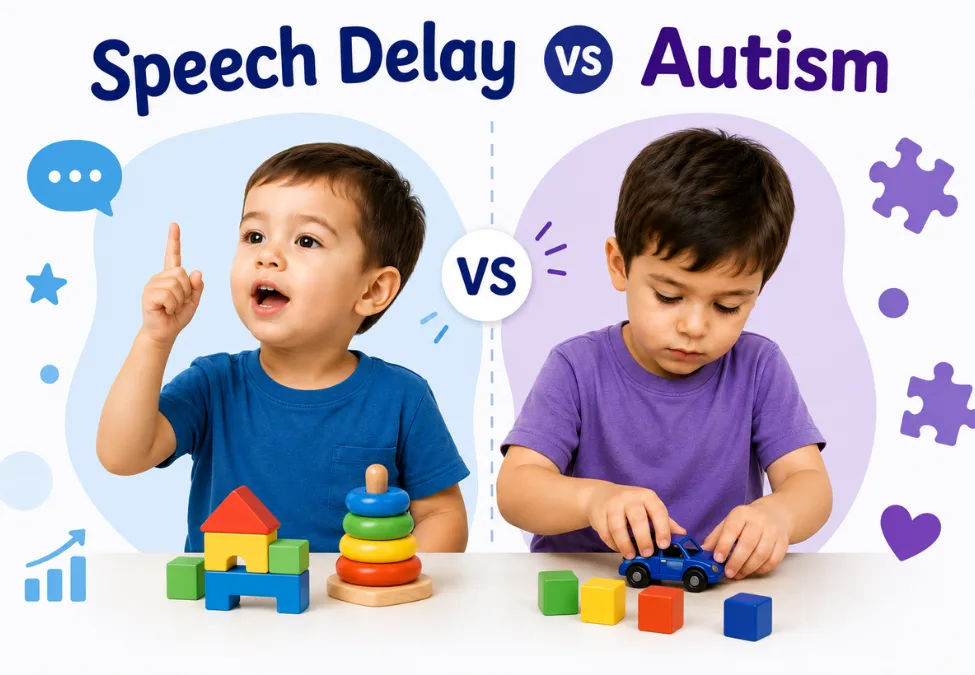
A child with a speech delay usually wants to communicate but struggles to produce words. In contrast, a child with autism often experiences challenges in the social use of communication, even before spoken language develops.
This distinction is what specialists look for during an evaluation.
Speech Delay vs Autism: Side-by-Side Comparison
| Development Area | Speech Delay | Autism Spectrum Disorder |
|---|---|---|
| Speech Development | Delayed speech but communication intent is usually strong | Speech may be delayed, unusual, or develop typically, but social communication differs |
| Understanding Language | Often understands much of what is said | Understanding may vary, especially in social contexts |
| Eye Contact | Usually maintains eye contact | May make limited or inconsistent eye contact |
| Gestures | Frequently points, waves, and uses gestures | Gestures may be limited or absent |
| Response to Name | Usually responds consistently | May not consistently respond despite normal hearing |
| Social Interest | Enjoys playing and interacting with others | May prefer solitary activities or find social interaction difficult |
| Joint Attention | Points to share interests with parents | May rarely point simply to share enjoyment |
| Pretend Play | Develops imaginative play appropriately | Pretend play may be limited or repetitive |
| Repetitive Behaviours | Not typically present | Common feature of autism |
| Sensory Differences | Usually not significant | Frequently present |
| Need for Routine | Flexible | May become distressed by changes in routine |
It is important to remember that no single behaviour confirms or rules out autism. Professionals look at the overall developmental pattern rather than isolated symptoms.
Communication Style: The Key Difference
Parents often focus on the number of words their child says. However, specialists pay closer attention to how a child communicates before they speak.
Children with Speech Delay
A child with an isolated speech delay usually tries hard to communicate.
They often:
- Point to desired objects
- Wave goodbye
- Bring toys to parents
- Smile during interaction
- Use facial expressions
- Show excitement when sharing experiences
- Look back and forth between an object and a parent
Although spoken words may be delayed, the desire to connect with others remains strong.
Children with Autism
Children with autism may communicate differently.
Parents might notice that their child:
- Uses fewer gestures
- Rarely points to share interesting things
- Doesn't consistently seek shared attention
- Has limited facial expressions
- Finds back-and-forth interaction difficult
- Uses another person's hand as a tool instead of pointing
These differences often become noticeable during the second year of life.
Joint Attention: One of the Earliest Clues
One of the most important developmental skills professionals assess is joint attention.
Joint attention refers to a child's ability to share focus on an object or event with another person.
For example:
A toddler sees an airplane in the sky.
Instead of simply looking at it, they point toward the airplane and then look back at their parent as if to say,
"Look! Did you see that too?"
This simple behaviour reflects several important developmental skills:
- Social awareness
- Communication
- Eye contact
- Shared enjoyment
- Early language learning
Children with speech delay usually develop joint attention appropriately, even if they aren't speaking much.
Children with autism often show reduced or delayed joint attention, making it one of the earliest signs clinicians observe during assessment.
Can a Child Have a Speech Delay Without Autism?
Yes. In fact, many children with speech delay do not have autism.
This is one of the most reassuring facts for parents to understand. While speech delay can sometimes be one feature of Autism Spectrum Disorder (ASD), it is not a diagnosis of autism on its own.
Speech and language development can be delayed for many reasons, and most of these are unrelated to autism. Some children simply need more time to develop spoken language, while others may have hearing difficulties, oral-motor challenges, or language disorders that affect speech without impacting their social development.
What matters most is the overall pattern of development.
For example, a toddler who says very few words but:
- Responds to their name
- Makes good eye contact
- Points to show interesting things
- Enjoys interactive games
- Copies actions and facial expressions
- Brings toys to parents to share excitement
is generally showing strong social communication skills. Although their speech may be delayed, these behaviours are less suggestive of autism.
This is why professionals never diagnose autism based solely on delayed speech.
Instead, they evaluate the child's communication, social interaction, play, behaviour, learning, sensory processing, and developmental history together.
Can a Child Have Autism Without a Speech Delay?
Yes.
Another common misconception is that every autistic child has delayed speech. While many do experience language delays, some children develop spoken language at the expected age.
However, they may still show differences in how they use language socially.
For example, a child might:
- Speak in long sentences but struggle to hold a conversation.
- Repeat phrases from television shows instead of answering questions.
- Talk extensively about one favourite topic without noticing whether others are interested.
- Have difficulty understanding jokes, sarcasm, or figurative language.
- Find it challenging to take turns during conversations.
These children may appear highly verbal, but they still experience the core social communication differences associated with autism.
This highlights an important point:
Autism is not defined by how many words a child can say. It is defined by differences in social communication and behaviour.
Common Causes of Speech Delay
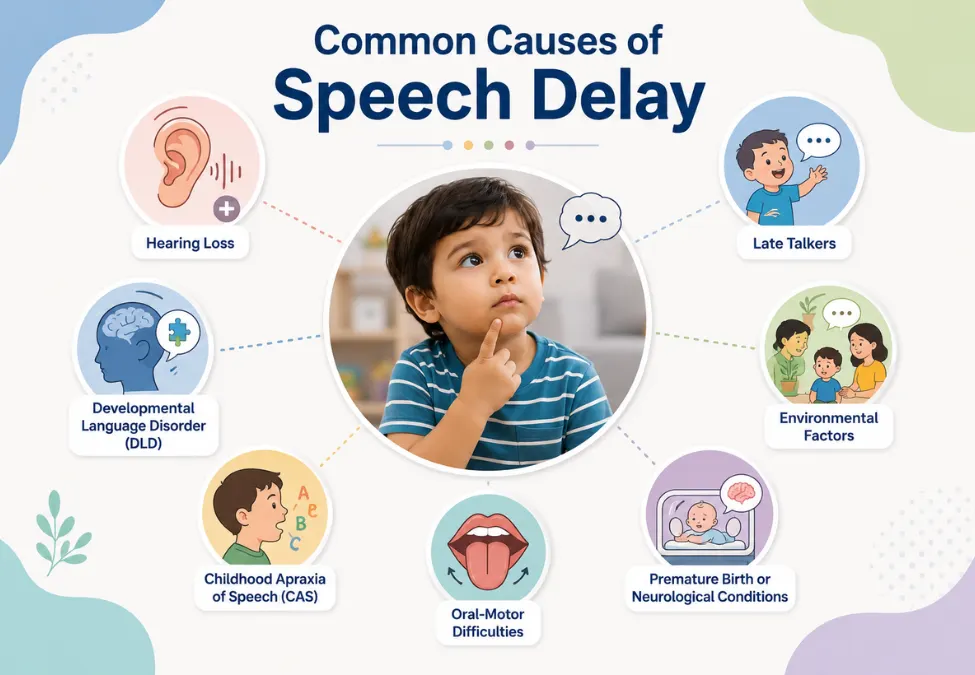
Speech delay is a symptom rather than a condition itself. Identifying the underlying cause helps professionals recommend the most appropriate intervention.
Below are some of the most common reasons a child may experience delayed speech.
1. Hearing Loss
Children learn language by listening to the voices around them.
Even mild or temporary hearing loss caused by repeated ear infections can make it difficult for children to hear speech sounds clearly, affecting language development.
Signs that may suggest hearing concerns include:
- Frequently saying "what?"
- Not responding consistently to sounds
- Turning up the television volume
- Delayed speech despite otherwise typical development
A hearing assessment is often one of the first evaluations recommended for children with speech delays.
2. Developmental Language Disorder (DLD)
Developmental Language Disorder is a condition in which children have persistent difficulties understanding and/or using language despite normal hearing, intelligence, and opportunities to learn.
Children with DLD may:
- Learn new words slowly
- Struggle with grammar
- Find it difficult to form sentences
- Have trouble following complex instructions
Unlike autism, children with DLD usually have age-appropriate social interests and enjoy interacting with others.
3. Childhood Apraxia of Speech (CAS)
Childhood Apraxia of Speech is a motor speech disorder in which the brain has difficulty planning the precise movements needed for speech.
Children with CAS often know what they want to say but struggle to coordinate the movements required to produce clear words.
They may:
- Produce inconsistent speech sounds
- Have difficulty imitating words
- Speak with unusual rhythm or stress
- Become frustrated while attempting to talk
Because CAS requires specialized assessment, evaluation by a speech-language pathologist is essential.
4. Oral-Motor Difficulties
Speech depends on coordinated movement of the lips, tongue, jaw, and palate.
Weakness or poor coordination of these muscles can affect speech clarity and sound production.
Children may also have difficulty with:
- Blowing bubbles
- Drinking through a straw
- Chewing certain foods
- Producing specific speech sounds
5. Premature Birth or Neurological Conditions
Children born prematurely or with certain neurological conditions may reach speech and language milestones later than their peers.
Many make excellent progress with early intervention and ongoing developmental support.
6. Environmental Factors
Children learn language through everyday interactions.
Frequent conversations, shared play, reading books together, singing songs, and responsive communication all support language development.
On the other hand, limited opportunities for interaction or excessive passive screen time may contribute to slower language development. However, these factors alone do not cause autism.
7. Late Talkers
Some toddlers simply begin speaking later than expected.
These children are often called late talkers.
Although they have limited spoken vocabulary, they typically:
- Understand language well.
- Follow simple instructions.
- Use gestures effectively.
- Enjoy interacting with family members.
- Show curiosity about people.
- Develop imaginative play.
Many late talkers catch up naturally, while others benefit from speech therapy to strengthen language skills.
Developmental Speech and Language Milestones
Every child develops at their own pace, but developmental milestones provide helpful guidance for identifying when additional evaluation may be beneficial.
The following milestones represent general expectations rather than strict rules.
Around 12 Months
Most children begin to:
- Babble using a variety of sounds.
- Say simple words like "mama" or "dada."
- Respond to their name.
- Point to objects they want.
- Wave goodbye.
- Use gestures to communicate.
- Make eye contact while interacting.
Possible Red Flags:
Consider discussing your concerns with a healthcare professional if your child:
- Do not babble.
- Rarely responds to their name.
- Does not point or wave.
- Shows limited interest in interacting with others.
Around 18 Months
Most toddlers:
- Use approximately 10-20 meaningful words.
- Point to familiar objects when named.
- Follow simple instructions.
- Enjoy copying adults.
- Bring objects to show parents.
Possible Red Flags:
Seek professional advice if your child:
- Uses very few words.
- Does not point to request or share.
- Shows little interest in communicating.
- Rarely imitates sounds or actions.
Around 24 Months (2 Years)
By two years of age, many children:
- Use at least 50 meaningful words.
- Begin combining two words into short phrases such as "more juice" or "Daddy come."
- Follow two-step directions.
- Enjoy pretend play.
- Ask simple questions.
- Communicate wants and needs clearly.
Possible Red Flags:
An evaluation is recommended if your child:
- Uses fewer than 50 words.
- Does not combine two words.
- Rarely communicates with gestures.
- Does not engage in pretend play.
- Has difficulty understanding simple instructions.
- Shows repetitive behaviours or limited social interaction.
Around 3 Years
Most children:
- Speak in short sentences.
- Ask many questions.
- Participate in conversations.
- Tell simple stories.
- Play imaginatively with others.
- Follow multi-step instructions.
Possible Red Flags:
Consult a developmental professional if your child:
- Is difficult for familiar people to understand.
- Rarely interacts with other children.
- Has limited pretend play.
- Loses previously acquired words or skills.
- Shows repetitive movements or intense interests that interfere with daily activities.
When Should Parents Seek a Professional Evaluation?
Every child develops differently, and occasional variations in milestones are common. However, certain signs should never be ignored.
Consider arranging a developmental evaluation if your child:
- Is not babbling by 12 months.
- Does not point, wave, or use gestures for 12-15 months.
- Has no meaningful words by 16-18 months.
- Is not combining two words by 24 months.
- Stops using words they previously knew.
- Rarely responds to their name.
- Avoids eye contact consistently.
- Shows repetitive body movements such as hand flapping or spinning.
- Becomes extremely distressed by minor changes in routine.
- Appears unusually sensitive to sounds, lights, or textures.
Remember, these signs do not automatically mean a child has autism. They simply indicate that a comprehensive developmental assessment is appropriate.
Early evaluation helps identify the reason behind a child's communication challenges and allows families to access the right support as early as possible.
One delayed milestone does not define a child's future. What matters is the overall developmental pattern and how a child communicates, interacts, learns, and responds to the world around them.
If you have concerns, seeking an evaluation is not about labeling your child, it's about understanding their unique strengths and needs so they can receive the support that helps them thrive.
How Do Professionals Tell the Difference Between Speech Delay and Autism?
One of the biggest challenges for parents is that the early signs of speech delay and autism can sometimes look similar. A toddler who isn't talking much may raise concerns about both conditions.
However, healthcare professionals don't make a diagnosis based on a single symptom like delayed speech. Instead, they look at the child's overall pattern of development, including communication, social interaction, play skills, behaviour, sensory responses, and developmental history.
A comprehensive assessment helps determine whether a child has an isolated speech delay, autism spectrum disorder, or another developmental condition.
Speech-Therapy Assessment
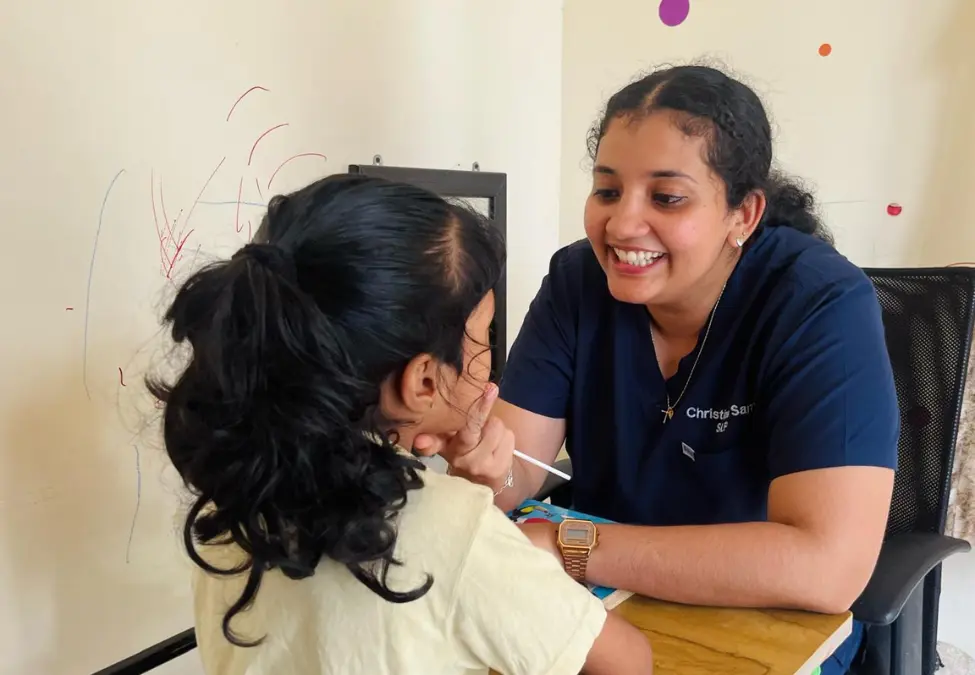
A Speech-Language Pathologist (SLP) evaluates how a child understands and uses language.
The assessment may include:
- Speech sound development
- Vocabulary and sentence formation
- Understanding of language
- Non-verbal communication
- Play and interaction skills
- Oral-motor function
- Feeding and swallowing concerns (if present)
An SLP can identify whether the difficulty is primarily related to speech production, language development, or social communication.
Having difficulty finding an expert Speech Therapist. We’ll help you out - Check here
Developmental Assessment
If autism is suspected, a clinician experienced in autism evaluations conducts a broader developmental assessment.
This typically includes:
- Social communication skills
- Eye contact
- Joint attention
- Play behaviour
- Repetitive movements
- Sensory processing
- Emotional regulation
- Developmental milestones
- Family observations
Parents play an essential role during this process because they provide valuable information about the child's behaviour across different settings.
Hearing Evaluation
Because hearing is fundamental to language development, a hearing assessment is recommended for nearly every child with delayed speech.
Even mild hearing loss or repeated ear infections can affect language learning.
Ruling out hearing difficulties is often one of the first steps before beginning speech therapy.
Occupational Therapy Assessment
If a child experiences challenges with sensory processing, motor coordination, self-care, or attention, an Occupational Therapist may also be involved.
They evaluate areas such as:
- Fine motor skills
- Gross motor skills
- Sensory processing
- Daily living skills
- Attention and regulation
- Play abilities
For children with autism, occupational therapy often complements speech therapy by supporting participation in everyday activities.
We’ll also help you out on spotting on a Occupational Therapist - Check here
Why Early Intervention Matters
One of the most encouraging things parents should know is that early intervention can make a significant difference.
During the first few years of life, a child's brain is developing rapidly. This period of growth provides an excellent opportunity to strengthen communication, learning, and social skills through appropriate intervention.
Whether a child has an isolated speech delay or autism, receiving support early can improve:
- Communication abilities
- Learning readiness
- Social interaction
- Emotional regulation
- Independence
- Confidence
- Participation at home and school
Importantly, early intervention is not about changing who a child is - it is about helping them develop the skills they need to communicate, learn, and participate more comfortably in everyday life.
Treatment for Speech Delay
Treatment depends on the underlying cause of the speech delay.
For many children, speech Language Therapy is the primary intervention.
A Speech-Language Pathologist creates an individualized therapy plan based on the child's strengths and specific communication needs.
Speech therapy may focus on:
Improving Speech Sounds
Some children know what they want to say but struggle to pronounce words clearly.
Therapy helps improve:
- Articulation
- Speech clarity
- Oral-motor coordination
- Sound production
Building Language Skills
Children with language delays may work on:
- Learning new vocabulary
- Combining words into sentences
- Understanding questions
- Following directions
- Using grammar appropriately
- Developing conversation skills
Supporting Social Communication
Even children without autism sometimes need help learning conversational skills such as:
- Taking turns
- Asking questions
- Maintaining topics
- Understanding non-verbal communication
Treatment for Autism Spectrum Disorder
Because autism affects multiple areas of development, intervention is often multidisciplinary.
Rather than focusing only on speech, therapy aims to support communication, participation, learning, sensory regulation, and independence.
The exact combination of therapies depends on the child's individual needs.
Speech Therapy
Speech therapy remains an important part of autism intervention.
Goals may include:
- Functional communication
- Language development
- Social communication
- Conversation skills
- Understanding emotions
- Pragmatic language
For children who are minimally verbal, therapists may introduce Augmentative and Alternative Communication (AAC) systems, such as picture-based communication or speech-generating devices, to support meaningful communication.
Occupational Therapy
Occupational therapy helps children participate more successfully in everyday activities.
Areas commonly addressed include:
- Sensory regulation
- Fine motor skills
- Self-care activities
- Handwriting readiness
- Play skills
- Attention
- Emotional regulation
The goal is to help children become more independent and engaged in home, school, and community life.
Behavioural and Developmental Interventions
Some children benefit from structured developmental or behavioural approaches that focus on building communication, social interaction, daily living skills, and learning through positive reinforcement.
Intervention plans are individualized and often involve close collaboration between therapists, educators, and families.
Gratus Kids, led by Dr. Dheeraj, offers comprehensive Speech Therapy, Occupational Therapy, and Developmental Therapy for children. Services are available at its centres in Palakkad and Coimbatore, with online consultations also available for families who prefer remote access to expert care.
What Parents Can Do at Home
Parents are a child's first and most important communication partners.
Small, consistent interactions throughout the day often have a greater impact than long teaching sessions.
Here are practical ways to support communication at home.
Talk Throughout the Day
Describe everyday activities as they happen.
For example:
"We're washing your hands."
"Look at the big red ball."
"Let's open the door."
These simple conversations expose children to new vocabulary in meaningful situations.
Read Together Every Day
Reading supports vocabulary, listening, imagination, and language development.
Instead of rushing through a story:
- Ask simple questions.
- Point to pictures.
- Wait for your child to respond.
- Encourage pointing and commenting.
Even a few minutes of shared reading each day can make a meaningful difference.
Follow Your Child's Interests
Children learn best when they're engaged.
If your child loves cars, bubbles, animals, or blocks, use those interests to encourage communication.
Join their play rather than directing it.
Communication grows naturally when children are motivated.
Encourage Gestures
Communication begins long before spoken words.
Celebrate and encourage:
- Pointing
- Waving
- Nodding
- Showing objects
- Reaching
- Facial expressions
These early communication skills often support later language development.
Reduce Passive Screen Time
Young children learn language through interaction with people, not from passively watching screens.
Replacing some screen time with conversation, shared play, singing, and reading creates more opportunities for communication.
Celebrate Every Attempt to Communicate
Communication isn't just about words.
If your child points, looks at you, makes a sound, signs, or uses a picture to communicate, respond positively.
Every successful interaction builds confidence and encourages future communication.
Common Myths About Speech Delay and Autism
Misinformation can increase anxiety and delay appropriate support. Let's address some common myths.
Myth: Every child with a speech delay has autism.
Fact: Many children with speech delay do not have autism. Speech delay can occur for various reasons, and a comprehensive developmental assessment is needed to identify the underlying cause.
Myth: Every autistic child cannot speak.
Fact: Autism is a spectrum. Some autistic individuals are minimally verbal, while others develop fluent speech. The key difference lies in social communication rather than speech alone.
Myth: Boys naturally talk late, so it's always okay to wait.
Fact: While there is normal variation in development, significant speech delays should always be evaluated rather than dismissed based on gender.
Myth: Bilingual children develop speech delays.
Fact: Research shows that learning two languages does not cause speech delay or autism. Children growing up in bilingual environments can successfully learn multiple languages.
Myth: If my child eventually starts talking, there is no need for therapy.
Fact: Some children catch up naturally, but others continue to experience difficulties with language, learning, or social communication. Early assessment helps determine whether intervention is beneficial.
Hearing your child say their first words is a milestone every parent looks forward to. When those words don't come as expected, it's natural to feel worried and to wonder whether a speech delay could be something more.
The most important thing to remember is that speech delay and autism are not the same. While delayed speech can sometimes be one feature of autism, many children with speech delays do not have autism and go on to make excellent progress with the right support.
Rather than focusing on speech alone, pay attention to your child's overall communication. Do they make eye contact? Point to share interesting things? Respond to their name? Enjoy interacting with family? These social communication skills often provide valuable clues about a child's development.
If you have concerns, trust your instincts and seek a professional evaluation. Asking questions early does not mean something is wrong, it means you're giving your child the best opportunity to receive the support they need, if they need it.
Every child develops at their own pace, and with understanding, timely intervention, and a supportive environment, children with speech delays, autism, or other developmental differences can continue to learn, communicate, and thrive.
Insights from Dr. Dheeraj's Clinical Experience
Every child is unique, and every assessment tells a different story. Over the years, Dr. Dheeraj has worked with many children whose journeys highlight why speech delay and autism should never be judged by speech alone. Here are two real clinical experiences that demonstrate this.
"He Wasn't Talking" Was Only Part of the Story
“One consultation from my years working with children with developmental disorders has never left me. A 2½-year-old boy was brought in because he wasn't speaking. His parents were confident it was 'just a speech delay', after all, he'd picked up a few words from cartoons. They had already tried speech therapy alone for some time, but there was no real improvement. What they didn't realize was that their son also had underlying sensory processing difficulties and until those were addressed, speech therapy alone was never going to work.
As the evaluation unfolded, a fuller picture emerged. He rarely looked at his parents to share a moment of joy or curiosity. He didn't point to show them something interesting. He didn't consistently turn when his name was called. Left to himself, he'd line up his toys in neat rows, absorbed in his own world.
The speech delay was simply the tip of the iceberg. Beneath it lay the real challenge: difficulties in social communication, alongside repetitive behaviours and sensory sensitivities that had never been identified or addressed. This time, we didn't rely on speech therapy alone, we began a multidisciplinary intervention that also targeted his sensory needs alongside communication and behaviour. The difference was remarkable. Over time, his eye contact grew steadier, his play more connected, his engagement with the world richer.
In my experience, when therapy isn't working, the answer often isn't more of the same therapy - it's looking at what's been missed.”
A speech delay can sometimes be only one symptom of a broader developmental condition. When therapy is not producing expected results, it is important to reassess the child comprehensively rather than simply continuing the same intervention.
The Child Who Could Speak, Yet Had Autism
“Then there was a child who spoke really well for his age. 'Doctor, he speaks so well,' his parents told me right away. 'It can't be autism.' And they had a point, he knew all his colours, could say his ABCDs, count from 1 to 20, and even repeat entire cartoon dialogues word for word.
But I wasn't looking at how much he could say. I was looking at how he used it. And that's where the problem showed up. When I tried to have a simple back-and-forth conversation with him, it didn't work, he was repeating words, not really talking with me. He rarely shared his interests with others. He missed social cues completely. And even a small change in his routine upset him a lot.
I also noticed something his parents hadn't paid much attention to. He wandered around often, flapped his hands, jumped, made the same sounds again and again, and sang the same rhymes on repeat. These are common signs of vocal stimming. But to his parents, it was just 'something he does', nothing to worry about.
That's when it became clear: his problem wasn't speaking. It was using speech to connect with people. This case helped his family understand something important, autism isn't ruled out just because a child can talk or recite well. It's identified by looking at the full picture: how a child communicates, behaves, and responds to the world around them.”
A child who speaks fluently, knows letters, numbers, or rhymes can still have autism. The diagnosis depends on how the child communicates socially, interacts with others, and responds to their environment, not simply on how many words they can say.
These two cases demonstrate why speech alone should never be used to rule in or rule out - autism. Some children speak very little because underlying developmental challenges have not yet been identified. Others speak exceptionally well but struggle with social communication, flexibility, and meaningful interaction.
A comprehensive developmental evaluation looks beyond vocabulary. It considers communication, behaviour, sensory processing, play skills, social interaction, and developmental milestones together. Early identification allows the right interventions to begin sooner, giving children the best opportunity to reach their full potential.


Frequently Asked Questions
Clear, clinical answers to the most common questions parents ask about speech delays and autism.