For many children with autism spectrum disorder (ASD), everyday tasks that look simple from the outside can take enormous effort from the inside. Getting dressed, using a spoon, holding a pencil, joining a game, following a routine, coping with noise, or staying with a classroom task may all demand more sensory, motor, and emotional energy than most people realize.
Occupational therapy for autism focuses on these real-life moments by helping children build the motor, sensory, self-care, communication-supporting, social, emotional, and functional skills they need to participate more independently at home, at school, and in the community. Rather than trying to change who a child is, a pediatric occupational therapist looks closely at what is getting in the way of participation and builds support around the child’s strengths, needs, and daily life.
About 1 in 31 children (3.2%) aged 8 years has been identified with autism spectrum disorder in the United States.
Occupational Therapy for Autism
Occupational therapy, or OT, is about helping people take part in everyday life in a meaningful way. For adults, that may include working, cooking, managing a home, or using transport. For children, the picture is different. Their everyday occupations include playing, learning, eating, dressing, writing, interacting with others, following routines, and gradually becoming more independent.
That is why occupational therapy for children with autism is far more than a set of exercises done in a clinic room.
An occupational therapist looks at what the child is being asked to do, what part of the activity feels hard, what abilities are already in place, and what support could make participation easier. Two children with the same autism diagnosis may therefore need very different occupational therapy plans.
For one child, the main need may be handwriting and fine motor control. For another, it may be dressing, feeding, sensory regulation, or classroom participation. Many children need support across several areas because development does not happen in neat, separate boxes.
A child who feels overwhelmed by classroom noise, for example, may struggle to stay seated and focused. That can then affect listening, written work, organizing materials, and interacting with classmates. OT pays attention to these links instead of treating each difficulty as an isolated problem.
Why Might a Child With Autism Need Occupational Therapy?
Autism affects each child differently.
Current CDC surveillance shows that autism was identified 3.4 times more often in boys than girls, while still occurring across all racial, ethnic, and socioeconomic groups.
Some children communicate well verbally but find sensory input, motor planning, or self-care especially hard. Others may have significant communication needs alongside challenges with attention, regulation, feeding, or daily routines.
Parents may notice that their child:
- Needs substantial help with dressing, grooming, or toileting.
- Finds certain sounds, textures, movements, or environments overwhelming.
- Has difficulty using pencils, scissors, handwriting tools, or other everyday equipment.
- Struggles with balance, coordination, or active play.
- Finds transitions and changes in routine especially difficult.
- Has trouble staying with everyday tasks long enough to finish them.
- Needs repeated adult support to complete routines that are already familiar.
- Finds shared play or turn-taking difficult to manage.
These challenges do not automatically mean a child is refusing to cooperate. Often, the child does not yet have the sensory, motor, cognitive, emotional, or organizational skills needed to manage the activity independently.
This is where occupational therapy becomes especially useful. Instead of focusing only on what the child cannot do, the therapist asks why the task is difficult and what can change so the child can succeed with less struggle.
How Does Occupational Therapy Help Children With Autism?
Occupational therapy can support several core areas of development. The exact priorities depend on the child’s assessment, strengths, needs, family concerns, and the environments they move through every day. Occupational Therapy helps in:
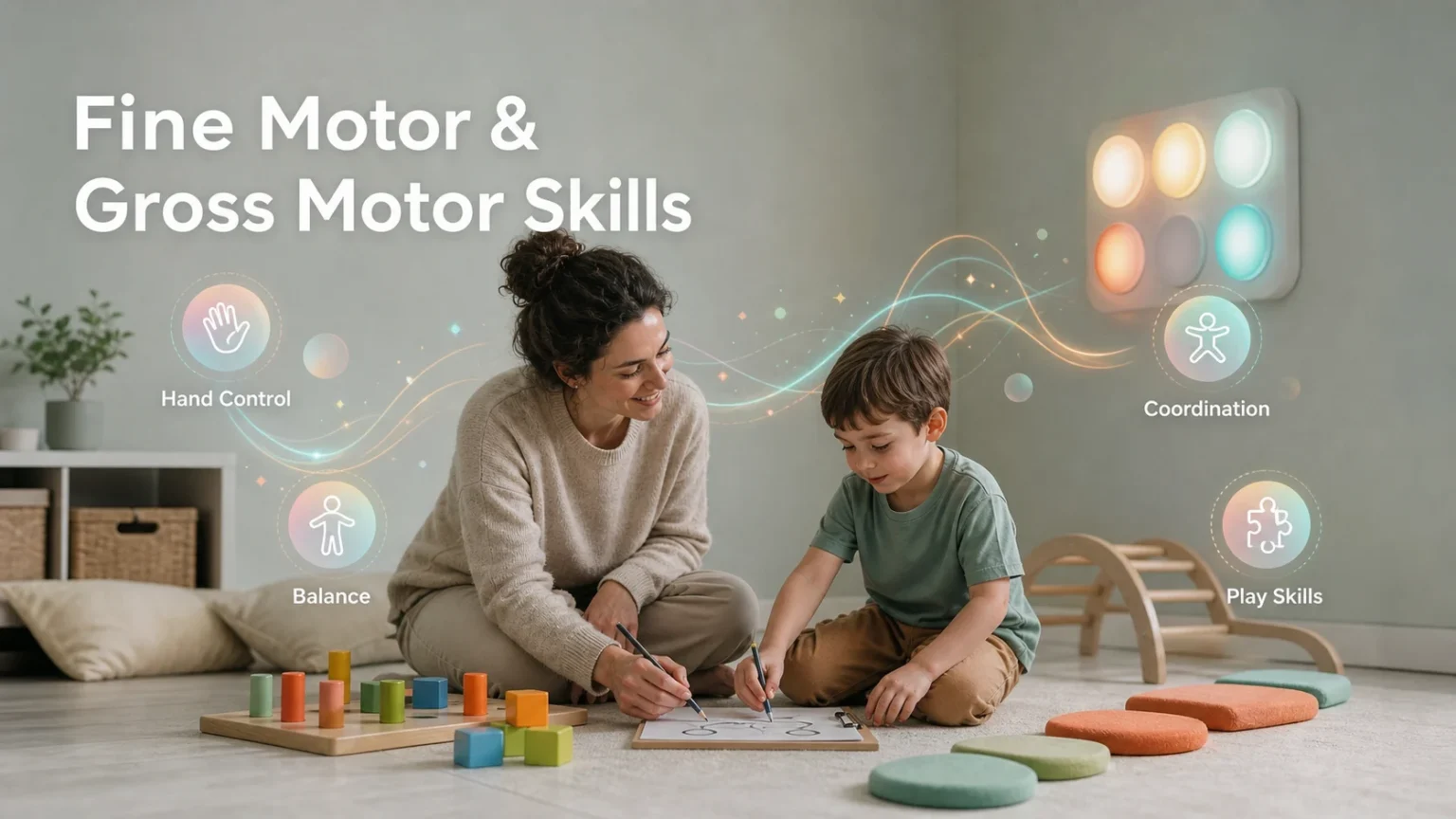
Building Fine Motor and Gross Motor Skills
Motor skills sit underneath many everyday activities.
A 2024 review reported that most included studies found 50% to 88% of children with ASD had significant motor impairments on standardized assessments, and another large study found 35.4% met criteria for motor difficulties.
Fine motor skills involve the precise work of the hands and fingers. Children use them for handwriting, drawing, cutting with scissors, opening containers, managing toys, using utensils, fastening buttons and zippers, and handling classroom tools.
When a child struggles with handwriting, the issue is not always a lack of practice. A therapist may need to look at hand strength, dexterity, pencil grasp, bilateral coordination, posture, visual-motor integration, and motor planning.
Therapy can then use purposeful activities that strengthen these underlying skills while still feeling engaging and achievable for the child.
Gross motor skills involve larger body movements such as balance, coordination, jumping, climbing, running, catching, and overall body control. These abilities shape playground participation, physical play, classroom mobility, posture, and many other parts of daily life.
An occupational therapist may use obstacle courses, catching games, balance work, climbing, jumping, crawling, and movement-based play to develop these abilities. The aim is not simply to make a child better at exercises. It is to help those abilities travel into everyday life.
Developing Daily Living and Self-Care Skills
One of the most practical parts of pediatric occupational therapy is helping with activities of daily living, often called ADLs.
Think about a typical school morning. A child may need to get dressed, brush their teeth, eat breakfast, pack a bag, put on shoes, and leave on time. To an adult, that can feel like one familiar routine. To a child, it may be a chain of separate sensory, motor, and organizational demands.
OT helps break those demands into manageable steps and gradually reduce how much adult support is needed.
Dressing, Grooming and Personal Care
Occupational therapy may support:
- Getting dressed and undressed with less help.
- Managing buttons, zippers, and other fasteners.
- Brushing teeth and hair more comfortably.
- Handling washing and bathing routines.
- Building more independence in toileting routines.
- Organizing and completing personal-care sequences.
A child may know exactly what is supposed to happen but still struggle with the motor planning, sequencing, sensory tolerance, or attention needed to carry it through. When the real barrier is identified, the support becomes much more useful.
Feeding and Mealtime Participation
Feeding often involves sensory, motor, behavioral, and functional factors all at once.
Some children may have difficulty using spoons or forks, sitting comfortably at the table, tolerating certain textures, participating in family mealtime routines, or accepting a wider range of foods.
An occupational therapist may work on the relevant functional parts of feeding and mealtime participation, while more complex swallowing, nutritional, or medical concerns may need input from other professionals. The goal is to help the child take part in meals as safely, comfortably, and independently as possible.

Supporting Sensory Processing in Autism
Sensory processing is one of the most talked-about areas in autism and occupational therapy, and for good reason.
In a large population-based sample of 25,627 autistic children, 74% had documented sensory features. Research estimates sensory differences in roughly 53% to 94% of autistic populations.
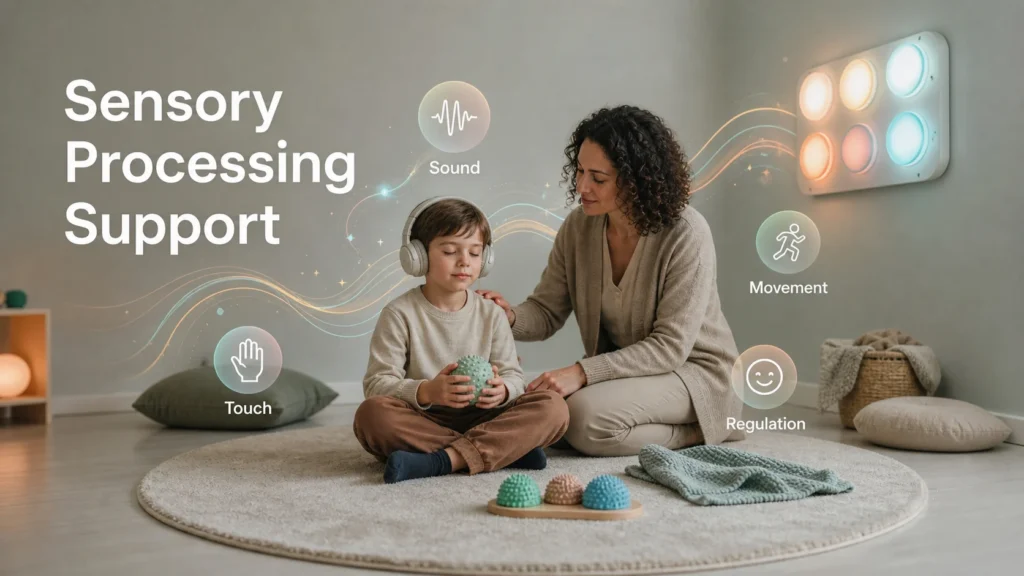
Children take in sensory information from sound, touch, movement, sight, smell, taste, and from the body’s muscles and joints. An autistic child may experience or respond to some of these sensations in ways that differ from what others expect.
A child may cover their ears in a noisy classroom, avoid certain clothing textures, dislike hair brushing, constantly seek movement, or become distressed in crowded places. Those responses can have a real effect on daily participation.
A child who seems unable to concentrate may actually be working hard just to stay regulated in a sensory environment that feels too loud, too busy, or too unpredictable.
An occupational therapist can assess how sensory differences connect to specific functional challenges and may recommend individualized strategies involving sensory modulation, movement opportunities, task adaptation, environmental changes, or visual structure.
What Is Sensory Integration Therapy?
Sensory integration therapy is an occupational therapy approach that uses structured sensory-motor experiences to support how a child processes and responds to sensory information. Current OT practice places more emphasis on assessment and individualized goals than on assuming every autistic child needs the same sensory program.
The goal should not simply be: Give the child more sensory activities. A better question is: What sensory difficulty is interfering with this child’s participation, and what individualized strategy is most likely to help? That keeps sensory support connected to real life instead of turning it into a generic routine.
Managing Sensory Overload Through Environmental Changes
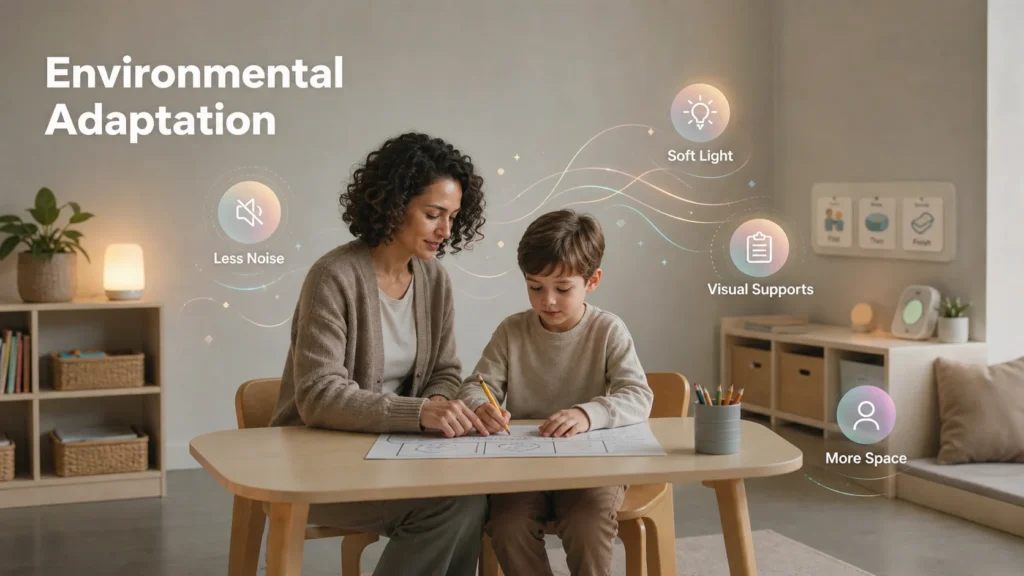
Sometimes the most helpful change is not asking more of the child. It is changing the environment around them.
A busy classroom, harsh lighting, excessive noise, crowded spaces, unpredictable routines, or visually cluttered surroundings can all create real barriers for some autistic children.
Occupational therapists may therefore recommend environmental changes that make participation easier and more sustainable.
At home, that might mean clearer routines or better-organized materials. At school, it might involve seating changes, fewer distractions, visual instructions, or adjustments to lighting and noise.
NICE clinical guidance recognizes environmental adaptations, including changes to noise, lighting, personal space, and other physical features, as potentially helpful for autistic children and young people.
Core OT Principle: Independence often improves when barriers are removed, not just when the child is asked to try harder.
Supporting Emotional Regulation and Coping
Some autistic children struggle with emotional regulation when they face sensory overload, sudden changes, communication difficulties, hard tasks, or stressful transitions.
That distress may show up as crying, withdrawal, refusal, running away, or a meltdown. In many cases, the behavior is not random. It is communication from a child who is overwhelmed or unable to express a need in another way.
Occupational therapy can help children develop practical regulation strategies that match their developmental level. These may include noticing body signals, using calming routines, preparing for transitions, asking for breaks, or accessing supportive changes in the environment.
For younger children, co-regulation is often essential. An adult first helps the child feel safe, organized, and calm, and only then can more independent regulation begin to grow.
This is also a reminder that developmental areas rarely work in isolation. A child who cannot say, "This is too loud," may still communicate that need through behavior. Sensory support, communication support, and emotional regulation often need to work together.

Improving Attention and Executive Functioning
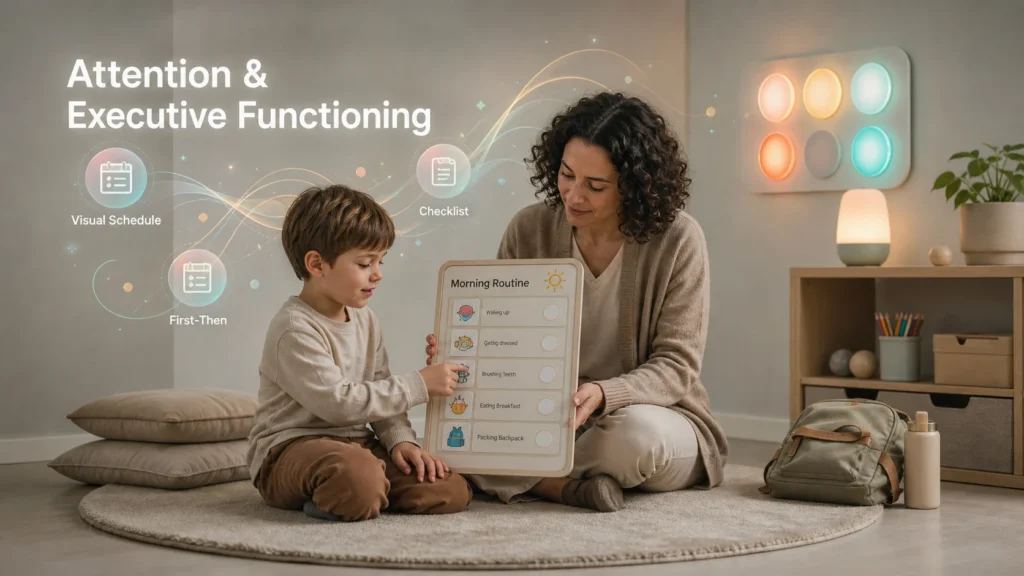
Executive functioning refers to the mental skills used to plan, organize, start, remember, shift between, and finish activities. For some autistic children, these skills are what make ordinary routines feel unexpectedly hard.
Consider the instruction: "Get ready for school." An adult may understand that instantly. A child may have to hold an entire sequence in mind:
An occupational therapist may make these routines easier to understand by using:
- Visual schedules
- First-then supports
- Picture cues
- Checklists
- Step-by-step routines
- Predictable transition strategies
These supports reduce how much information the child has to hold in mind and make expectations easier to see and follow. The larger goal is not simply better task completion during therapy. It is helping the child manage real routines at home and at school with more confidence and less prompting.
Supporting Play, Social Participation and Turn-Taking
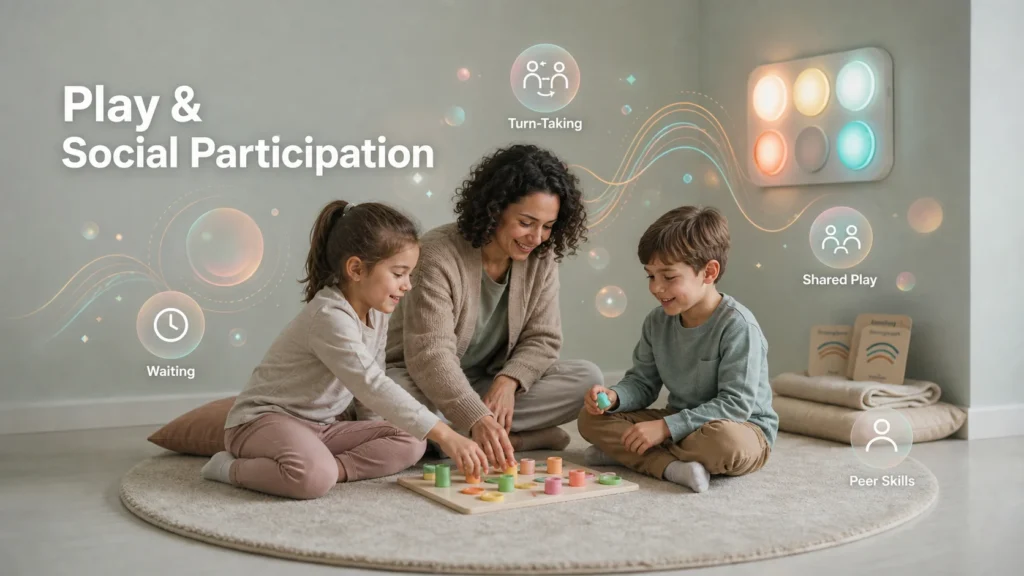
For children, play is not extra. It is one of the main ways development happens. Through play, children practise communication, movement, problem solving, flexibility, attention, cooperation, and social connection.
Occupational therapy may use structured and child-led activities to support:
- Turn-taking
- Shared play
- Waiting
- Following simple game routines
- Participating with peers
- Understanding physical boundaries
- Adapting to changes within play
A simple card game, for instance, may involve fine motor skill, attention, waiting, rule-following, communication, and social participation all at once. That is why play can be such a natural and effective place to practise multiple skills together.
OT may also work alongside speech-language therapists and educators when a child’s goals include broader social communication and interaction.
Using Visual Supports, Assistive Technology and AAC
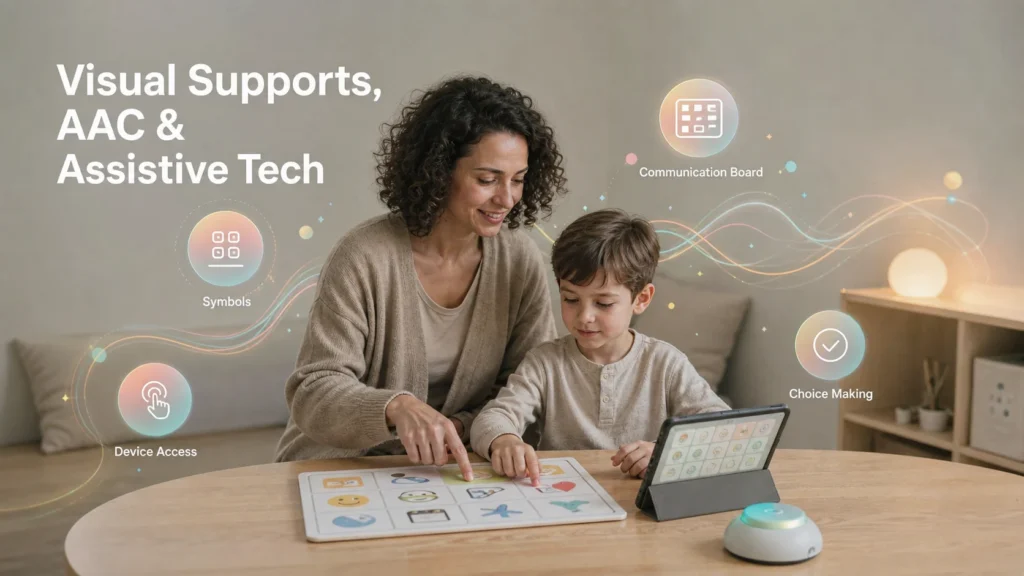
Not every child takes in spoken instructions with ease. Some autistic children benefit more from visual information such as schedules, symbols, picture instructions, written steps, checklists, or communication boards.
For children with significant communication needs, augmentative and alternative communication, or AAC, can offer another way to express wants, needs, thoughts, and choices. AAC may include picture-based communication, communication boards, or speech-generating devices.
Occupational therapists may contribute by supporting the physical and functional access needed to use communication or assistive systems well, while speech-language professionals often lead communication and language assessment and intervention.
The Guiding Goal: Communication should become more accessible, not more restrictive.
Using Therapeutic Activities to Build Real-World Skills
Occupational therapy activities are most useful when there is a clear reason behind them.
At the table, a therapist might use puzzles, sorting tasks, stickers, card games, crafts, construction activities, drawing, or object-placement tasks. These can support fine motor control, visual-motor skills, attention, planning, and task completion.
Movement-based therapy may include obstacle courses, catching games, balance work, crawling, jumping, animal walks, climbing, or other forms of therapeutic play. These can support gross motor coordination, postural control, motor planning, body awareness, and regulation.
The key point is that every OT activity should connect to a real functional goal:
- A puzzle might be used to strengthen visual-motor coordination.
- A sticker activity may build hand control and precision.
- An obstacle course can develop motor planning and sequencing.
- A card game may support turn-taking and shared social participation.
To the child, these activities may feel like play. To the therapist, they are carefully chosen opportunities to build skills that matter outside the therapy room.

How Is Occupational Therapy for Autism Planned?
Effective occupational therapy starts with assessment.
CDC surveillance reported a median age of earliest known autism diagnosis of 47 months in 2022, although timing varied widely across communities. Early identification allows targeted developmental support when the brain is most adaptable.
Rather than jumping straight into exercises, the therapist first tries to understand the child’s abilities, challenges, routines, preferences, environments, and functional priorities.
An assessment may look at:
- Fine and gross motor abilities
- Sensory processing
- Self-care and ADLs
- Feeding and mealtime participation
- Attention and executive functioning
- Emotional regulation
- Play and social participation
- Handwriting and school tasks
- Environmental demands
- Current level of independence
An OT assessment is not the same as an autism diagnosis. Diagnosis requires an appropriate developmental or clinical evaluation. Occupational therapy contributes a different kind of insight by showing how a child’s abilities and developmental differences affect everyday functioning.
After assessment comes individualized goal setting. A meaningful goal might be helping a child complete more dressing steps independently, use a spoon during meals, join a classroom task, improve pencil control, follow a visual routine, or take part in a simple turn-taking game. Intervention is then built around those goals and adjusted over time as the child progresses.
How Occupational Therapy Extends Into Home and School
A child spends only a limited amount of time with a therapist. Most of life happens at home, at school, and in the community. That is why family involvement matters so much.
Parents can learn how to weave therapy goals into daily routines instead of trying to create a completely separate exercise program. A therapist may show ways to support dressing, mealtimes, visual routines, transitions, play, or sensory needs in everyday moments.
The same principle applies at school. Teachers and therapists may work together on classroom seating, handwriting, tool use, transitions, visual supports, organization, playground participation, and other functional demands. This is how skills practised in therapy become useful in real life.
The broader multidisciplinary team may include:
- Occupational therapists
- Speech-language therapists
- Developmental pediatricians
- Psychologists
- Special educators
- Physiotherapists
- Teachers and caregivers
Each professional brings a different lens, but the child should experience that support as one connected plan rather than a series of disconnected services. At Gratus Kids, that integrated approach matters because families often need practical, coordinated support in one place rather than separate pieces they have to assemble on their own.
What Are the Benefits of Occupational Therapy for Autism?
The benefits of OT should always be judged against the individual child’s goals. When therapy addresses the barriers that are actually getting in the way, children may work toward:
- Greater independence: managing more steps of dressing or personal care.
- Better participation: actively joining classroom, play, family, and community activities.
- Stronger functional skills: coordination, tool use, attention, planning, and regulation.
- More confidence & quality of life: everyday tasks become less stressful and more manageable.
For one child, progress may mean putting on a shirt without help. For another, it may mean using a pencil with less effort and frustration. For another, it may mean joining a sibling in a game. And for another, it may simply mean being able to say or show, "I need a break."
These may look like small changes from the outside, but they can represent major steps toward independence, confidence, and meaningful participation.
Occupational therapy helps children with autism by connecting developmental skills to the realities of everyday life. It may address fine motor skills, gross motor development, sensory processing, sensory integration, activities of daily living, self-care, feeding, emotional regulation, executive functioning, attention, play, social participation, visual supports, AAC, assistive technology, and environmental adaptation.
Ultimately, occupational therapy for autism is about helping a child move from "I need help with everything" toward "I can do more of this myself," one meaningful everyday skill at a time.
Clinical Experiences from Practice
Every child is unique, and every assessment tells a different story. Over the years, Dr. Dheeraj N has worked with many children whose journeys highlight why speech delay and autism should never be judged by speech or surface behaviors alone. Here are two real clinical experiences that demonstrate this.
He Wasn’t Just “Running” — He Was Seeking a Sound
A 3-year-old child with Autism Spectrum Disorder (ASD) was brought to us with concerns about excessive running, limited attention, repetitive behaviours, reduced social interaction, and sensory differences. His parents described him as “always on the move” and initially wondered whether he was simply hyperactive.
In children with autism, constant running is often interpreted as proprioceptive seeking — especially when a child appears to be constantly looking for movement and body input. However, without a detailed sensory and behavioural assessment, the reason behind the movement can easily be misunderstood.
The Clinical Observation: During observation, we noticed something unusual. The child showed a strong interest in rhythmic and distinctive sounds, particularly temple chenda melam, devotional songs, and the jingling sound of an anklet. He was wearing an anklet himself, and whenever he ran, the movement produced a continuous jingling sound.
We then removed the anklet. His excessive running reduced significantly.
This simple observation provided an important clinical clue: part of his running behaviour appeared to be associated with seeking auditory sensory input, rather than being purely proprioceptive seeking or simply “hyperactivity.” However his communication, social interaction, sensory processing, and other developmental needs continued to require intervention, and therapy is ongoing.
The same behaviour can have very different reasons. A child who is constantly running may be seeking movement, pressure, visual input, auditory feedback — or may be responding to a combination of sensory and developmental factors.
Don’t just ask, “Why is the child running?” Ask, “What is the child getting from running?” Understand the purpose behind the behaviour as the first step towards effective intervention.
“Please Make My Child Stop Doing This…”
A worried parent brought their 4-year-old child to us with a simple request: “Doctor, please help us stop these behaviours.”
The child frequently watched spinning objects, stared at ceiling fans and lights, moved his fingers in front of his eyes, and repeatedly sought visually stimulating experiences. To the parents, these were simply unwanted behavioural problems. They tried everything they could — repeatedly asking him to stop, distracting him, taking away the objects, and encouraging him to behave like other children.
What they did not know was that these behaviours were not simply bad habits or intentional misbehaviour. The parents were also unaware that their child was showing features associated with Autism Spectrum Disorder (ASD). They had never heard of autism or understood how differently a child with autism might experience the world.
During a detailed developmental and sensory assessment, we looked beyond the behaviour and asked: “Why is he doing this?”
The assessment revealed significant sensory processing difficulties, particularly visual sensory seeking, along with other developmental features consistent with autism. The child was not doing these things to trouble his parents. He was trying to meet a sensory need in the only way he knew.
Instead of simply teaching him to “stop,” therapy focused on understanding his sensory needs, providing appropriate sensory experiences, and developing more functional ways for him to regulate, communicate, and participate in everyday life. For the parents, this was an emotional turning point. What they once saw as “my child’s bad behaviour” became “my child is trying to tell me something.”
Behind every behaviour, there may be an underlying sensory or developmental reason. Understand the reason before trying to change the behaviour. Early identification and appropriate intervention can make a meaningful difference in a child’s developmental journey.


Frequently Asked Questions
Clear, clinical answers to the most common questions parents ask about pediatric occupational therapy for autism.
No. Occupational therapy does not cure autism. Autism is a neurodevelopmental condition, and OT is one form of support that can address difficulties affecting everyday functioning and participation.
The goal is not to make a child seem less autistic. A more meaningful goal is to help the child communicate, learn, play, regulate, manage daily activities, participate in their environment, and become more independent in ways that fit who they are. That distinction matters because therapy should be built around meaningful outcomes, not unrealistic promises.
No. Sensory differences are common in autism, but not every child has the same sensory profile, and not every child needs sensory-based intervention.
Sensory strategies are most useful when they are based on assessment and tied to a real functional difficulty. The more useful question is not: What sensory activity should every autistic child do? It is: What sensory difficulty is affecting this child’s participation, and what evidence-informed strategy could help?
Parents may want to discuss an OT evaluation when everyday activities continue to feel significantly difficult for their child. Areas worth paying attention to include:
- Persistent difficulty with dressing, grooming, feeding, or other self-care tasks.
- Sensory responses that interfere with participation at home, school, play, or in the community.
- Fine motor or coordination difficulties affecting handwriting, tools, toys, or movement.
- Frequent difficulty with transitions and daily routines.
- Attention, organization, or regulation difficulties that disrupt functional activities.
- A level of adult assistance that remains high when greater independence would normally be expected.
There is no single age or single symptom that decides when OT is appropriate. The more important question is whether the child’s difficulties are limiting participation and quality of life.
A good occupational therapy program should begin with the individual child, not with a generic package of activities. Parents should be able to understand:
- What is being assessed?
- What are the therapy goals?
- Why are particular activities being chosen?
- How will progress be measured?
- How will the skills carry over into home and school life?
Therapy should connect to real-life participation and recognize the child’s strengths, interests, communication style, and individual needs. Most importantly, occupational therapy should not be reduced to fixing a child. Its purpose is to remove barriers, build useful skills, and support fuller participation in everyday life.
Yes. OT commonly supports functional activities such as dressing, grooming, feeding participation, routines, handwriting, motor skills, organization, and other daily tasks that contribute to independence.