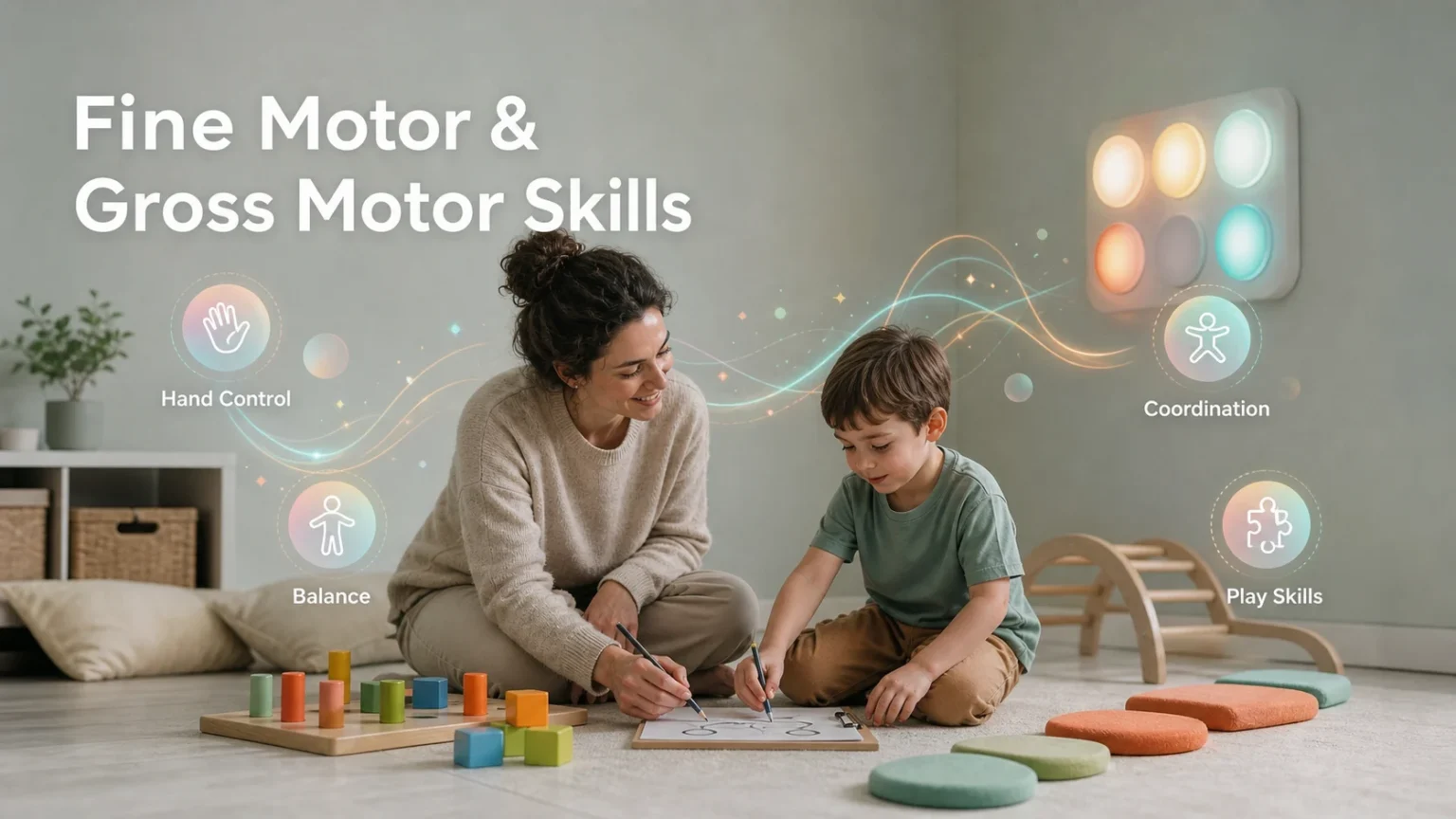
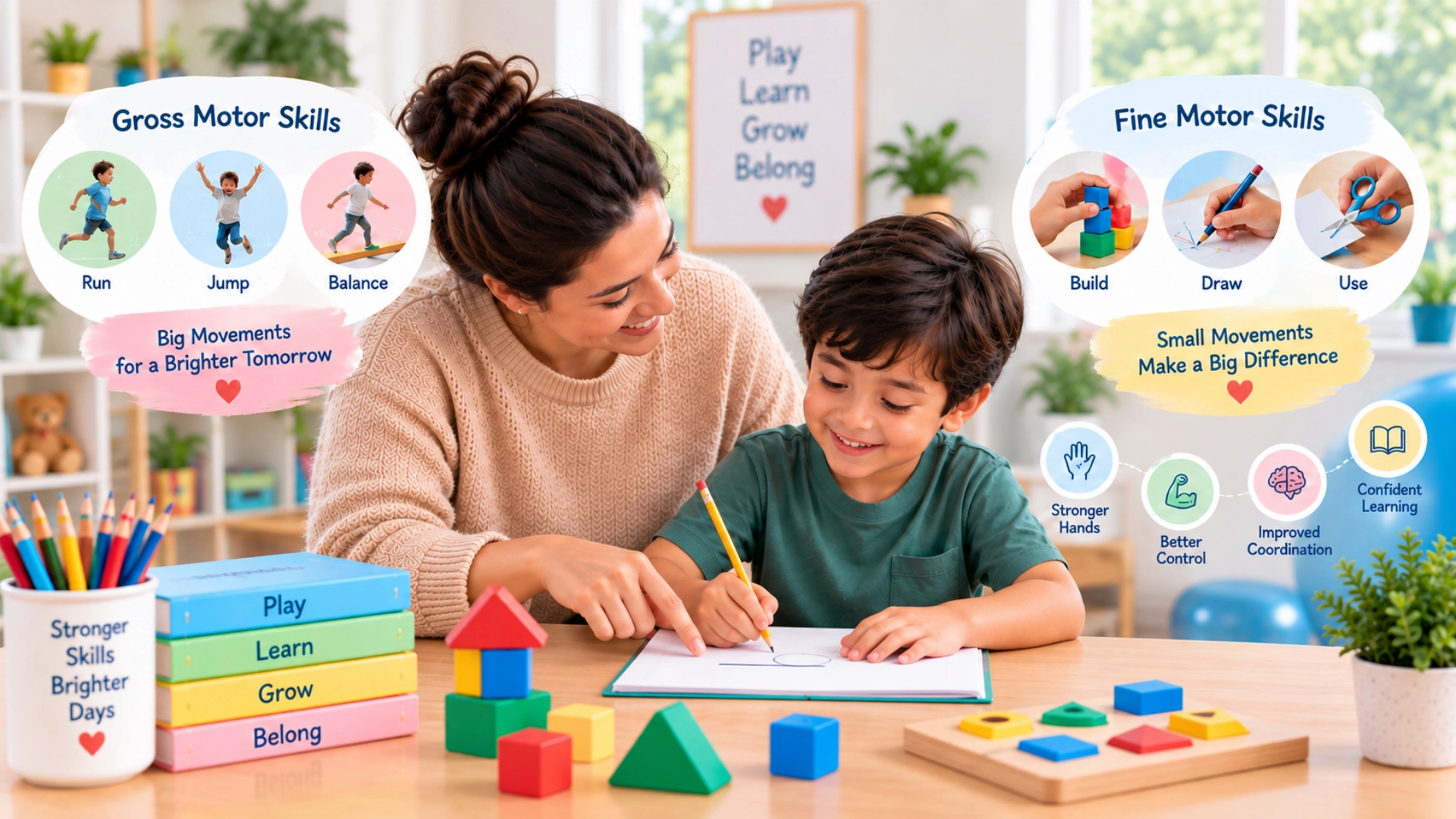
A child may have the strength to hold a pencil but still struggle to control it. They may be able to pick up a toy but find it difficult to use a spoon, button a shirt, cut with scissors, or build with blocks. Sometimes, these difficulties appear as messy handwriting, weak pencil grip, trouble using both hands together, difficulty with dressing, slow self-care skills, or avoiding activities that require precise hand movements. These are not simply “small problems.” Fine motor skills and motor coordination support many of the things children need to do every day, from playing and learning to eating, dressing, writing, and becoming more independent.
This is where Occupational Therapy (OT) can play an important role. Rather than simply asking a child to strengthen their fingers or practise handwriting repeatedly, pediatric occupational therapy looks at how the child moves, what makes the task difficult, and how those underlying skills affect meaningful activities. The goal is not just better hand movements; it is helping the child participate more successfully in play, school, self-care, and everyday life. This occupation-focused approach is central to occupational therapy practice.
What Is Motor Skill Development in Children?
Motor skill development is the gradual development of a child's ability to control and coordinate the body to perform movements effectively.
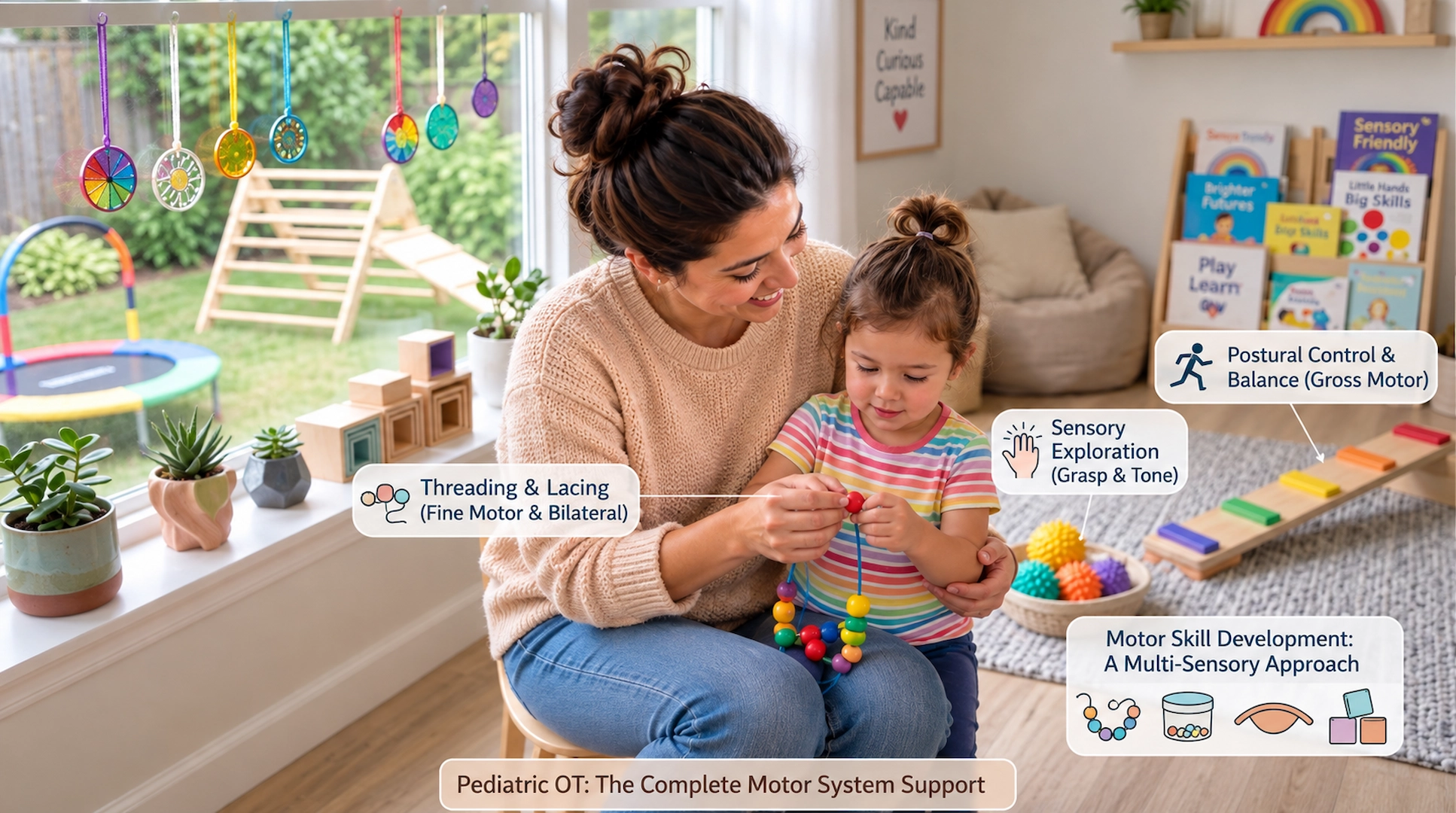
It includes both gross motor skills and fine motor skills.
Gross motor skills involve larger body movements such as running, jumping, climbing, balancing, and maintaining posture. Fine motor skills involve the smaller and more precise movements of the hands and fingers.
For example, when a child writes their name, several skills work together:
This is why a difficulty that appears to be “just handwriting” may actually involve several different components of motor performance.
Development also happens progressively. Children move through developmental milestones as they learn to play, learn, communicate, act, and move. Milestones can help parents and professionals notice whether a child may need additional developmental evaluation, although milestones themselves are not diagnostic standards.
Fine Motor Skills: The Foundation for Everyday Activities
Fine motor skills involve the controlled use of the small muscles of the hands and fingers. Children use these skills constantly, often without realizing it.
They need fine motor control to:
- Pick up and transfer objects
- Feed themselves with a spoon or cup
- Turn pages
- Build with blocks
- Draw and colour
- Use scissors
- Fasten buttons and zippers
- Tie shoelaces
- Manipulate small objects
- Write and complete schoolwork
But fine motor development is not only about the fingers. A child's hand strength, finger isolation, grasp, wrist stability, bilateral coordination, visual-motor integration, motor planning, and sensory processing can all influence how effectively the hands work.
This is why pediatric occupational therapy looks beyond the final movement and considers the complete motor system supporting it.
How Fine Motor Skills Develop With Age
Every child develops at their own pace, but motor development generally progresses from simpler movements toward increasingly precise and coordinated actions.
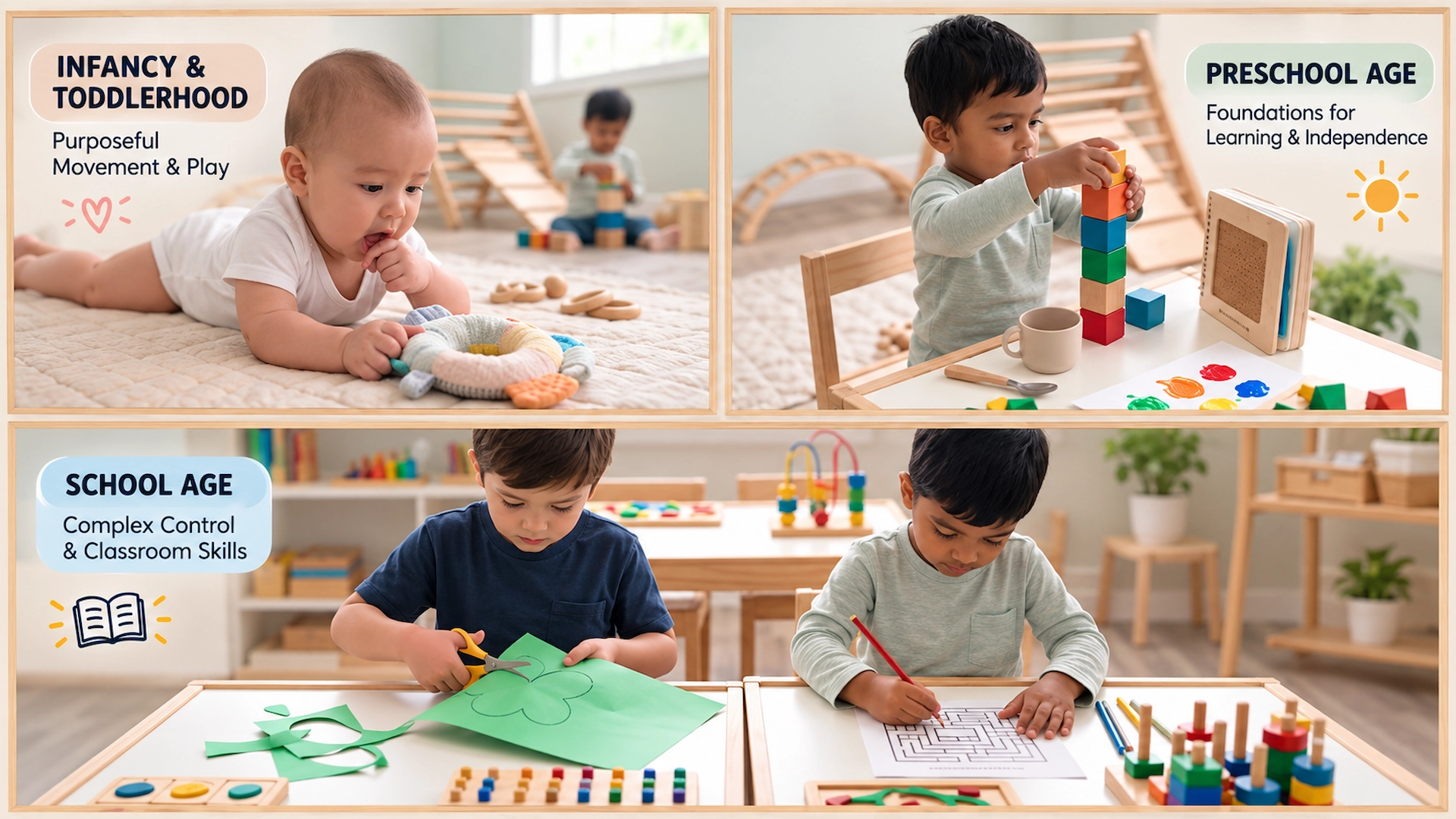
Infancy: 0-12 Months
During infancy, children begin developing the foundations of hand control. They gradually learn to:
- Reach toward and grasp objects
- Bring their hands and objects toward the mouth
- Transfer objects from one hand to another
- Explore toys using their hands
- Begin developing early finger control and emerging pincer movements
These early experiences provide the foundation for later manipulation and self-care skills. For example, learning to grasp and release a toy is an early step toward eventually holding a crayon, spoon, or pencil.
Toddlerhood: 1-3 Years
As hand control develops, children begin using their hands for more purposeful activities. They may start:
- Stacking blocks
- Scribbling
- Using spoons and cups
- Turning pages
- Manipulating simple toys
- Participating in finger-painting and play activities
At this stage, play is particularly important because children learn motor skills through repeated exploration and purposeful movement.
Preschool and School Age: 3-8 Years
As children grow, fine motor demands become more complex. They may need to:
- Use scissors accurately
- Trace and copy shapes
- Complete puzzles
- Draw pictures
- Manipulate classroom materials
- Develop more mature pencil control
- Write for longer periods
- Use both hands together efficiently
These skills become increasingly important because school places greater demands on handwriting, drawing, cutting, classroom participation, and independent self-care.
The Building Blocks Behind Fine Motor Control
When a child struggles with a fine motor task, it is useful to understand what happens underneath the movement.
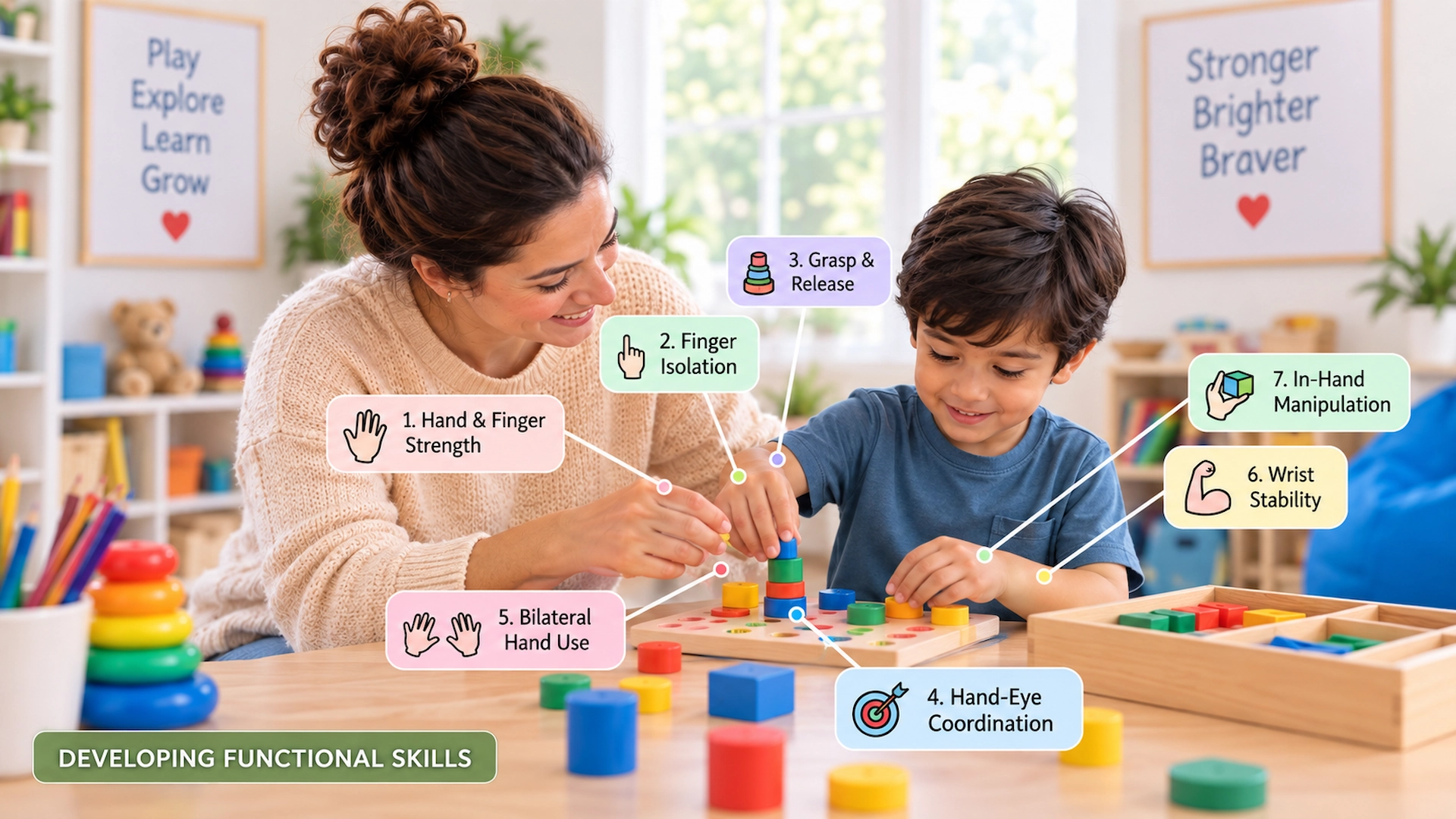
Hand and Finger Strength
Children need adequate strength to hold and manipulate objects. Weak hand muscles may make activities such as colouring, writing, opening containers, or using scissors tiring. However, strength alone is not enough. A child may have adequate strength but still struggle because their movements lack precision or coordination.
Finger Isolation
Finger isolation means being able to move individual fingers separately. This becomes important when children need to:
- Press individual keys
- Point
- Manipulate small objects
- Use a pencil
- Operate buttons
- Perform precise finger movements
Grasp and Release
Children need to learn how to pick up an object, hold it appropriately, adjust their fingers, and release it intentionally. The type of grasp changes as hand control develops.
Hand-Eye Coordination
Hand-eye coordination, also known as visual-motor coordination, allows children to use what they see to guide their hand movements. It is important for activities such as:
- Drawing
- Copying shapes
- Completing puzzles
- Building structures
- Cutting along a line
- Placing objects accurately
Bilateral Hand Use
Many everyday activities require both hands to work together. Think about opening a lunch box, holding paper while cutting, tying shoelaces, or stabilising a notebook while writing. This ability is called bilateral coordination.
Wrist Stability and Movement
The wrist provides a stable base from which the fingers can make precise movements. Good wrist positioning and control can support activities such as drawing, writing, cutting, and manipulating objects.
In-Hand Manipulation
In-hand manipulation refers to the ability to move and adjust an object within one hand. For example, a child may need to shift a pencil into a comfortable position or move a small object from the palm toward the fingertips.
These individual components are important, but they should not be viewed in isolation. The real objective is how these skills come together during meaningful activities.
The Neuroscience Behind Motor Skill Development
Motor skills are not developed by the hands alone. The brain, sensory systems, muscles, joints, vision, and movement systems continuously communicate to plan, execute, and adjust movement.
Several neurological systems contribute to this process. Corticospinal and corticobulbar pathways help transmit motor commands. The primary motor cortex contributes to voluntary movement, while somatosensory systems provide information about touch and body position. The cerebellum plays an important role in coordination, timing, and movement refinement.
Most importantly, motor learning is not static. The nervous system can adapt with experience, practice, and repeated use. This capacity for change is commonly referred to as neuroplasticity. That is one reason purposeful, repeated practice matters in pediatric occupational therapy. However, repetition by itself is not enough. The practice needs to be meaningful, appropriately challenging, and connected to the child's functional goals.
How Does Occupational Therapy Improve Motor Skills?
Occupational therapy improves motor skills by identifying the specific movement difficulties affecting a child's activities and then providing individualised, goal-directed and meaningful practice. The therapist may work on the underlying motor abilities, but the intervention is generally connected to what the child actually needs to do.
For example, if a child struggles to use scissors, occupational therapy may address hand strength and bilateral coordination while also giving the child opportunities to practise cutting. If handwriting is difficult, the therapist may work on pencil control and posture but also incorporate actual handwriting practice. If dressing is difficult, the intervention may involve finger control, bilateral hand use and motor planning while practising buttons, zippers or other dressing tasks.
This activity-based approach is important because motor learning develops through practice, feedback, adjustment and repetition. Research on pediatric occupational therapy supports interventions that use goal-oriented and activity-based approaches, although the strength of evidence varies across intervention types.
1. Occupational Therapy Develops Fine Motor Skills
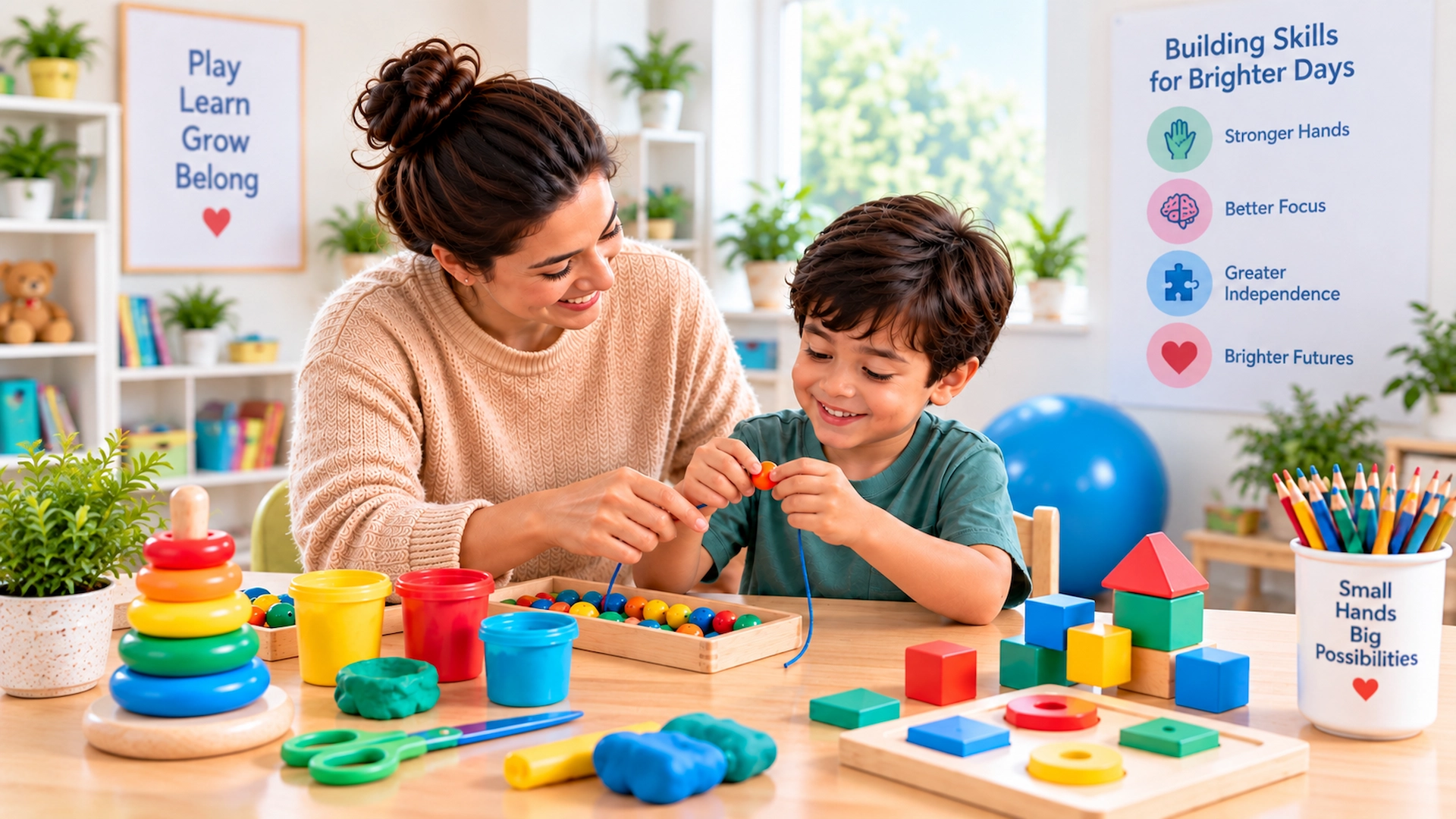
Fine motor skills are among the most common areas addressed in pediatric occupational therapy. A child may have difficulty picking up small objects, manipulating toys, using a pencil, fastening buttons, or controlling scissors. These activities require more than finger strength. They require precise coordination between the fingers, hand, wrist, arm and visual system.
An occupational therapist may therefore work on:
- Finger isolation
- Hand and finger strength
- Grasp and release
- Wrist stability
- In-hand manipulation
- Hand-eye coordination
- Bilateral hand use
These skills are gradually integrated into meaningful activities rather than treated as completely separate abilities. For example, threading beads can encourage finger control and bilateral coordination, while building with blocks can involve grasp, release, visual-motor skills and motor planning. The objective is not simply for the child to become better at threading beads or squeezing playdough. The objective is for developing skills to support real-life performance.
2. Occupational Therapy Improves Hand-Eye Coordination
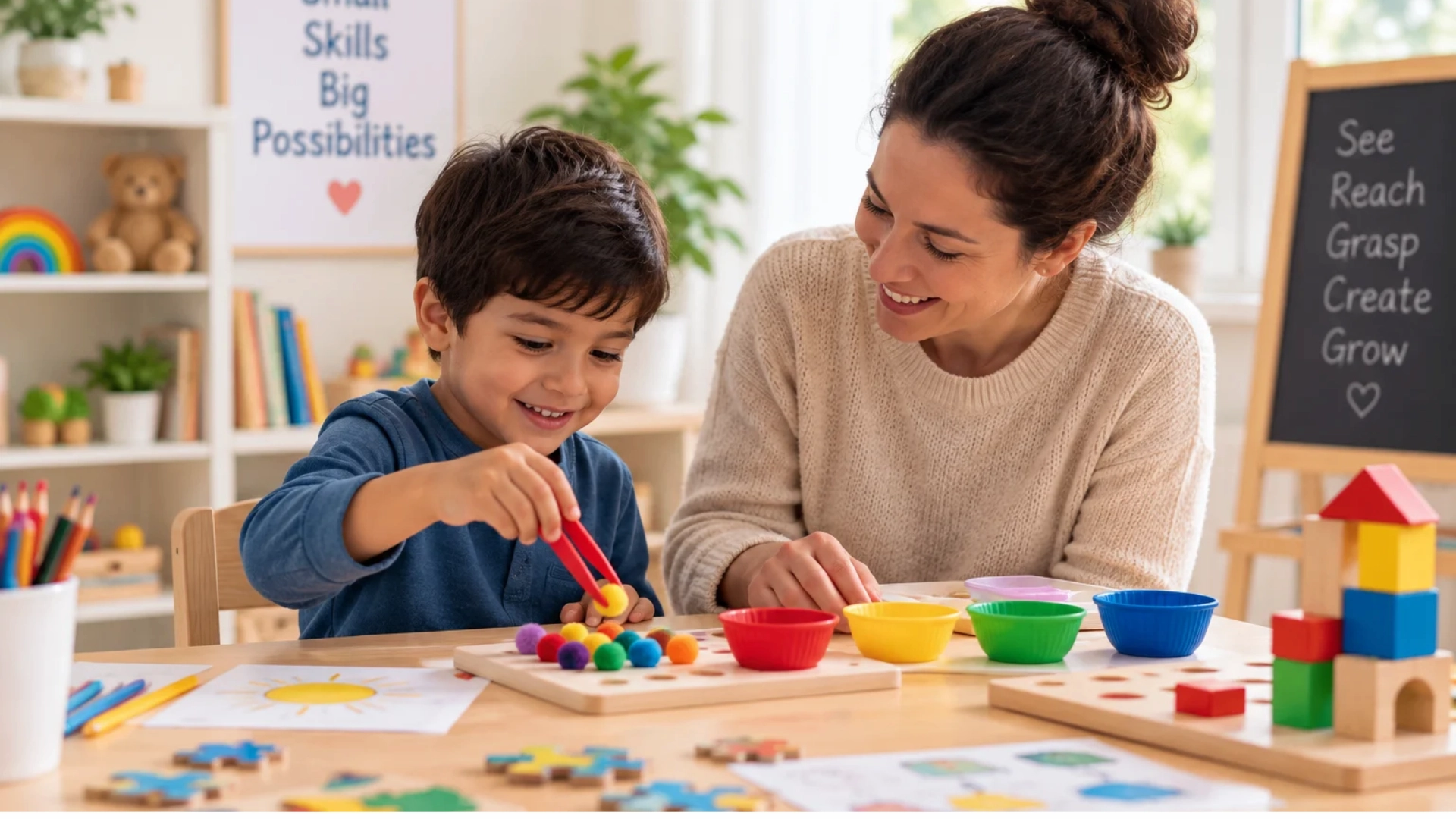
A child needs to use visual information to guide hand movements during many everyday activities. This is known as visual-motor integration or hand-eye coordination. It allows a child to see where an object is and adjust the hand accordingly.
It contributes to activities such as:
- Completing puzzles
- Drawing and colouring
- Building structures
- Placing objects accurately
- Cutting along lines
- Copying shapes and letters
- Catching and throwing
When visual information and movement do not work together efficiently, a child may appear clumsy or may take considerably longer to complete tasks. Occupational therapy can provide activities that gradually challenge this coordination while keeping the activity meaningful to the child.
3. Occupational Therapy Strengthens Bilateral Coordination
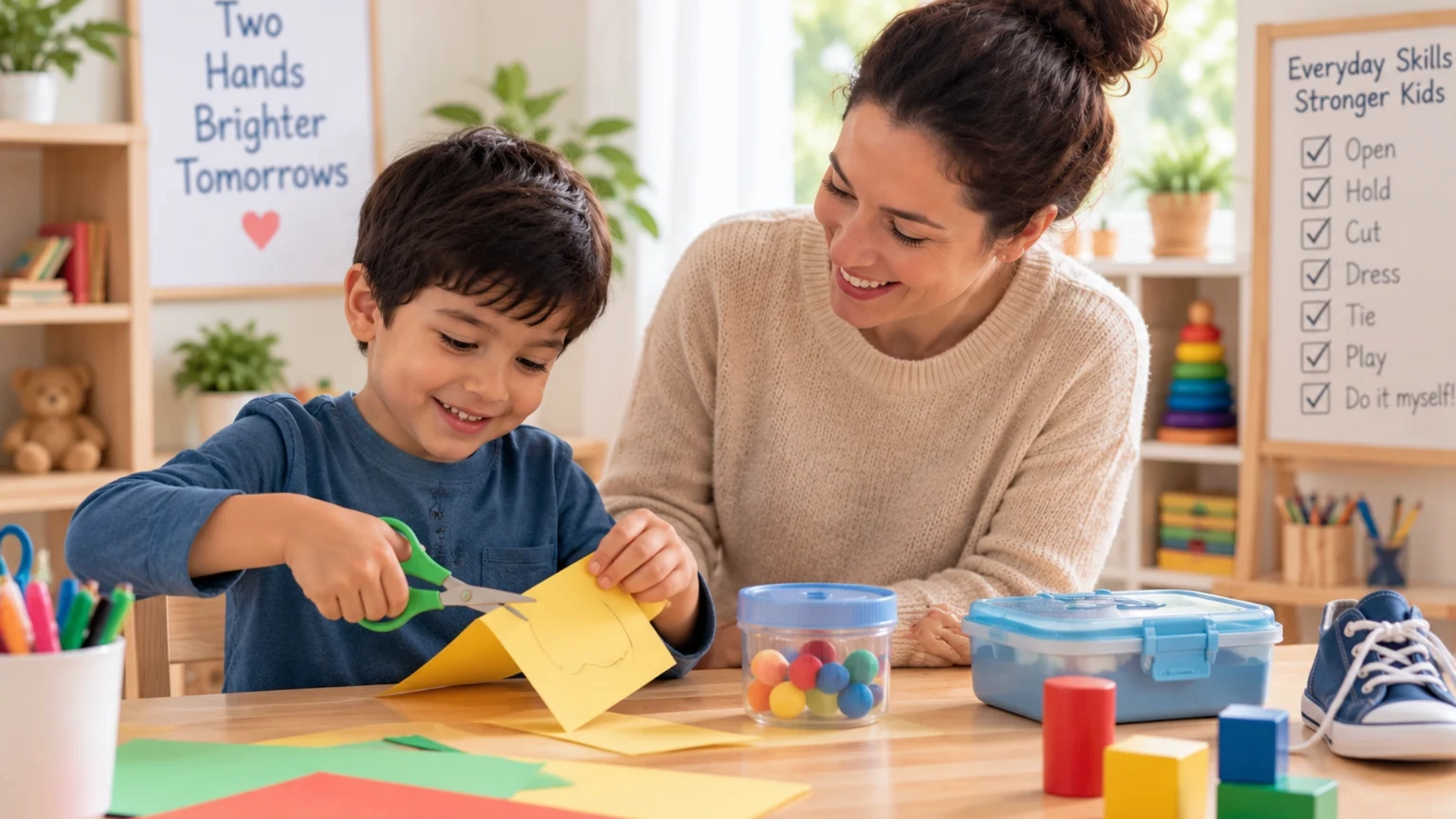
Many childhood activities require both hands to work together. Opening a container is one example. One hand stabilises the container while the other opens it. Cutting paper works similarly. One hand operates the scissors while the other hand holds and moves the paper. Dressing, tying shoelaces, opening lunch boxes and using classroom materials also require coordinated two-handed action.
An occupational therapist may therefore observe whether a child can use one hand as the primary working hand while the other hand stabilises or assists. Improving this coordination can make everyday activities more efficient and independent.
4. Occupational Therapy Supports Motor Planning
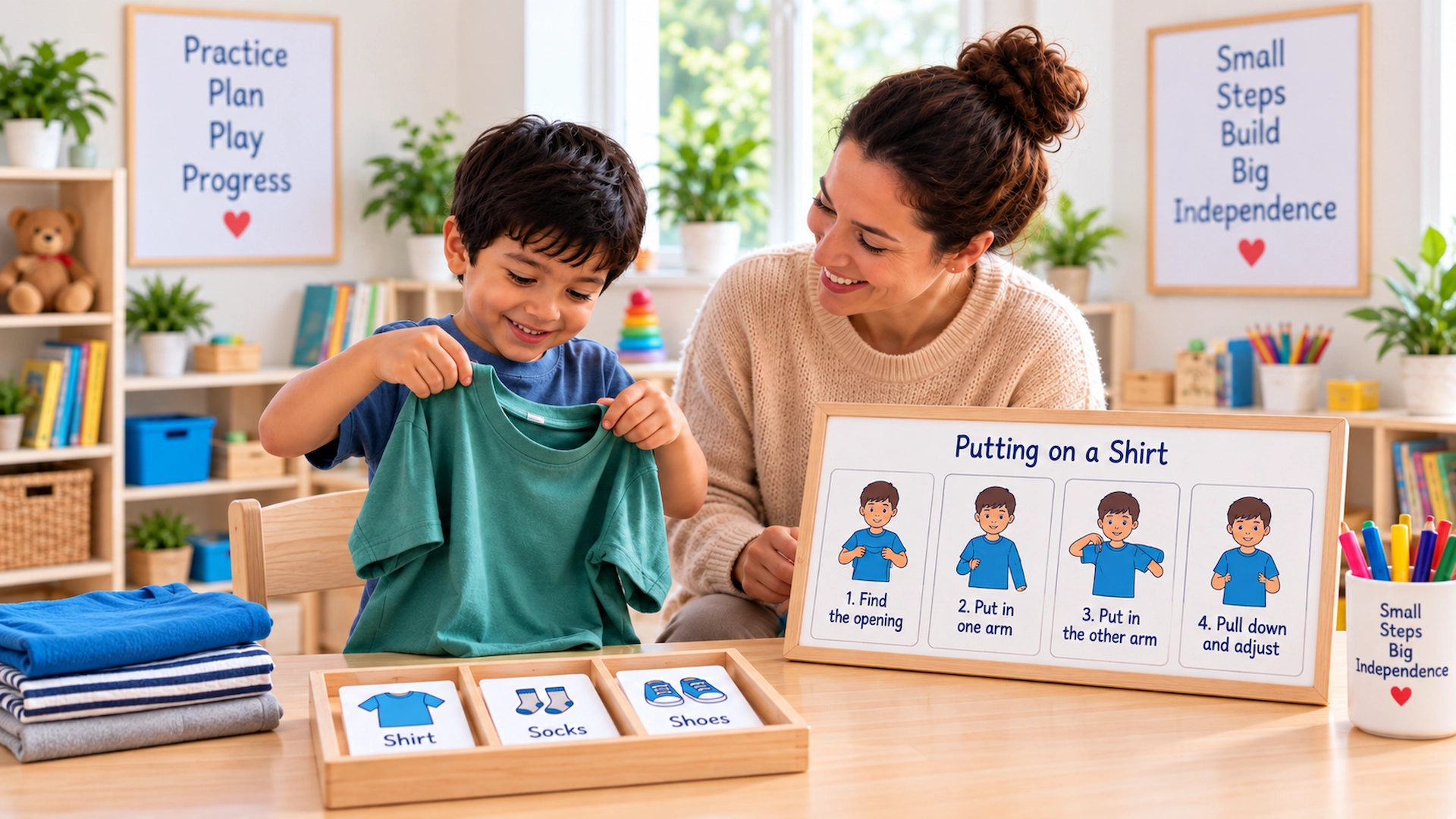
Motor planning, or praxis, refers to the ability to figure out, organise and carry out a new or unfamiliar movement. A child may understand what needs to be done but struggle with how to organise the movements.
For example, the child may know that a shirt needs to be put on but struggle to orient the shirt, find the correct opening, put the arms through and adjust it into position. Motor planning also contributes to:
- Learning new playground movements
- Building complex structures
- Using unfamiliar tools
- Completing multi-step craft activities
- Dressing independently
- Organising body movements during play
Occupational therapy can break complex activities into manageable steps, provide appropriate cues and gradually reduce assistance as the child becomes more capable.
5. Occupational Therapy Supports Handwriting Skills
Handwriting is one of the clearest examples of how motor skills affect school participation. A child may struggle with handwriting because of difficulties involving pencil control, hand coordination, visual-motor integration, posture, motor planning or the ability to sustain the task.
However, handwriting should not be approached only through isolated “hand strengthening” activities. Evidence-informed guidance from the American Occupational Therapy Association indicates strong support for therapeutic handwriting practice, while isolated activities targeting underlying components alone do not have the same evidence for improving handwriting outcomes.
This means occupational therapy may incorporate preparation activities when appropriate, but the child also needs opportunities to practise the actual functional task. The therapist may work with the child on:
The goal is ultimately better participation in school, not simply better performance on a hand exercise.
6. Occupational Therapy Helps Children Develop Self-Care Skills
Motor skills become particularly meaningful when they improve independence. A child may have difficulty dressing, feeding, grooming or managing personal belongings because the activity requires several motor abilities at the same time.
For example, independent dressing can require:
Occupational therapy can analyse where the breakdown occurs and modify the task or provide targeted practice. The therapist may work on activities such as:
- Using a spoon or fork
- Opening food containers
- Buttoning and unbuttoning
- Pulling zippers
- Managing clothing
- Brushing teeth
- Organising personal belongings
These are not secondary outcomes. They are meaningful occupations in a child's everyday life.
7. Occupational Therapy Uses Play to Build Motor Skills
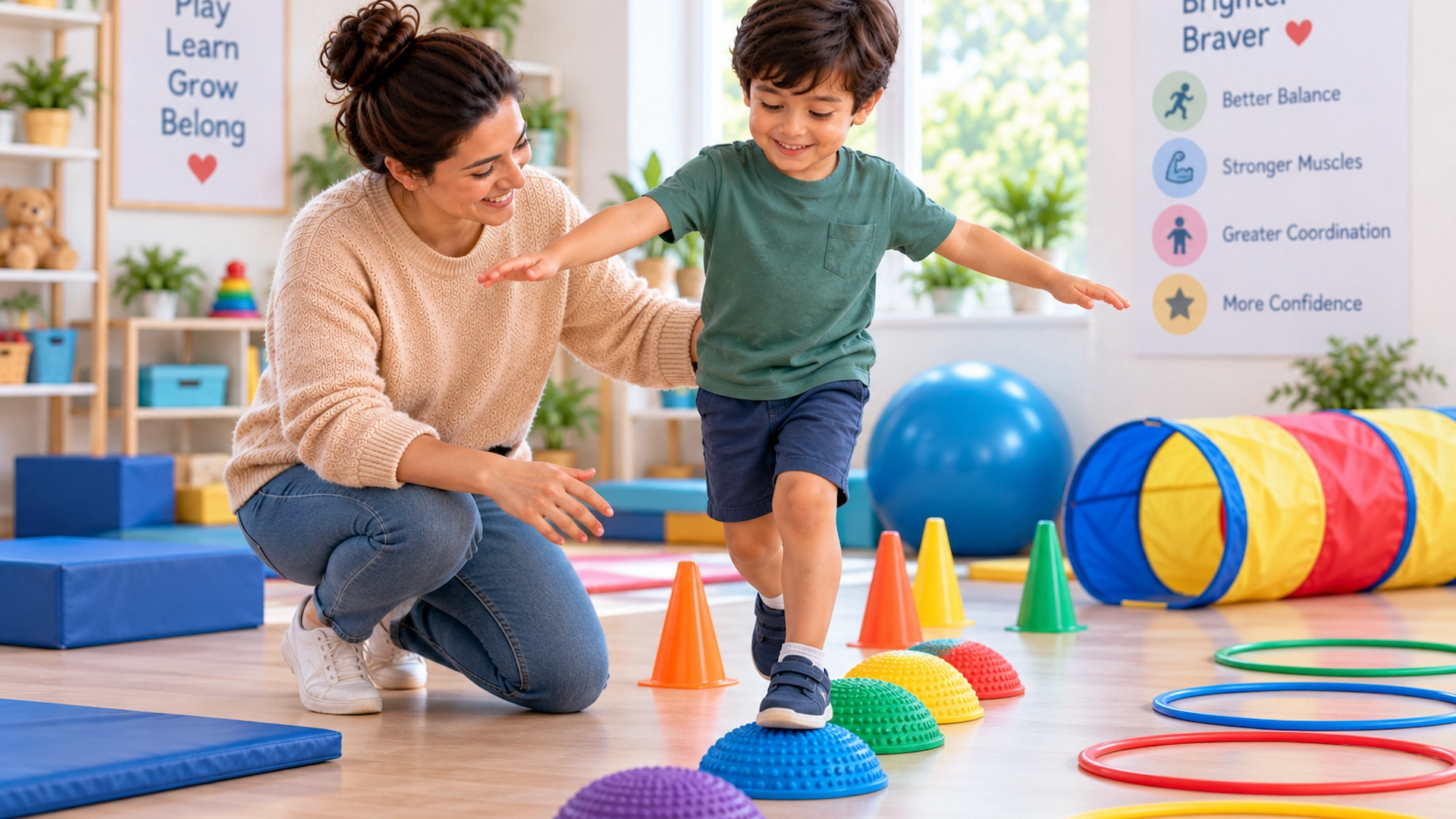
For children, play is one of the most natural environments for motor learning. A therapist can use play to create repeated opportunities for reaching, grasping, manipulating, balancing, planning and coordinating movements. Activities may include building blocks, threading beads, using play materials, puzzles, stickers, construction toys, tongs, drawing, cutting and other age-appropriate games.
The activity is selected according to the child's goals. A child who needs better finger control may benefit from manipulating small objects. A child who needs better bilateral coordination may participate in activities requiring both hands. A child who has difficulty with motor planning may be given activities that involve organising several movements in sequence. Research on fine motor interventions in young children has found generally positive effects, with meta-analytic evidence showing moderate effects on fine motor, visual-motor and manual-dexterity outcomes across the studies included.
8. Occupational Therapy Considers Sensory and Body Awareness
Movement depends partly on the information the nervous system receives from the body and the environment. Touch, proprioception, vision and information from the joints and muscles help children understand where their bodies are and how they are moving.
Some children may also find certain sensory experiences distracting or uncomfortable, which can affect their participation in motor activities. An occupational therapist may therefore consider sensory processing when it appears relevant to a child's functional difficulties. However, sensory activities should not automatically be treated as a solution for every motor problem. The intervention needs to be connected to the child's actual functional goals. This is another reason why assessment is important before deciding what type of occupational therapy intervention a child needs.
9. Occupational Therapy Uses the Right Level of Challenge
A motor activity that is too easy may not provide enough opportunity for development. An activity that is far too difficult may lead to frustration, avoidance or repeated failure. Occupational therapists therefore adjust activities according to the child's current ability. The therapist may change:
- The size of an object
- The amount of assistance
- The complexity of the task
- The number of steps
- The position of materials
- The amount of repetition
- The level of visual or physical support
As the child becomes more successful, the challenge can gradually increase. This creates a progression from supported performance to independent performance.
10. Occupational Therapy Connects Motor Skills With Real-Life Participation
The strongest reason to work on motor skills is not simply that motor scores improve. The real question is: What can the child do more independently because of those improvements?
A successful intervention may allow a child to write more comfortably in class. It may help another child dress without assistance. It may allow another child to participate in playground games. It may help another child feed themselves. This functional perspective is central to pediatric occupational therapy. A systematic review of pediatric OT found evidence for several approaches that target activity and participation, including goal-directed training, task-oriented approaches, coaching and home programmes, although effectiveness differs according to the intervention and population.
Why Play Is So Important in Occupational Therapy
For a child, play is not simply entertainment. Play is one of the natural ways children practise movement, problem-solving, coordination, exploration, and participation. A therapist may use activities such as threading beads, building blocks, rolling and pinching play materials, placing stickers, using tongs, or manipulating construction toys.
The purpose is not to make a child “do exercises.” The activity is selected because it creates an opportunity to practise a particular skill while remaining meaningful and engaging. This aligns with the occupation-focused philosophy of OT, where activities are intentionally selected to develop performance skills and improve participation in meaningful occupations.
From Fine Motor Skills to Handwriting
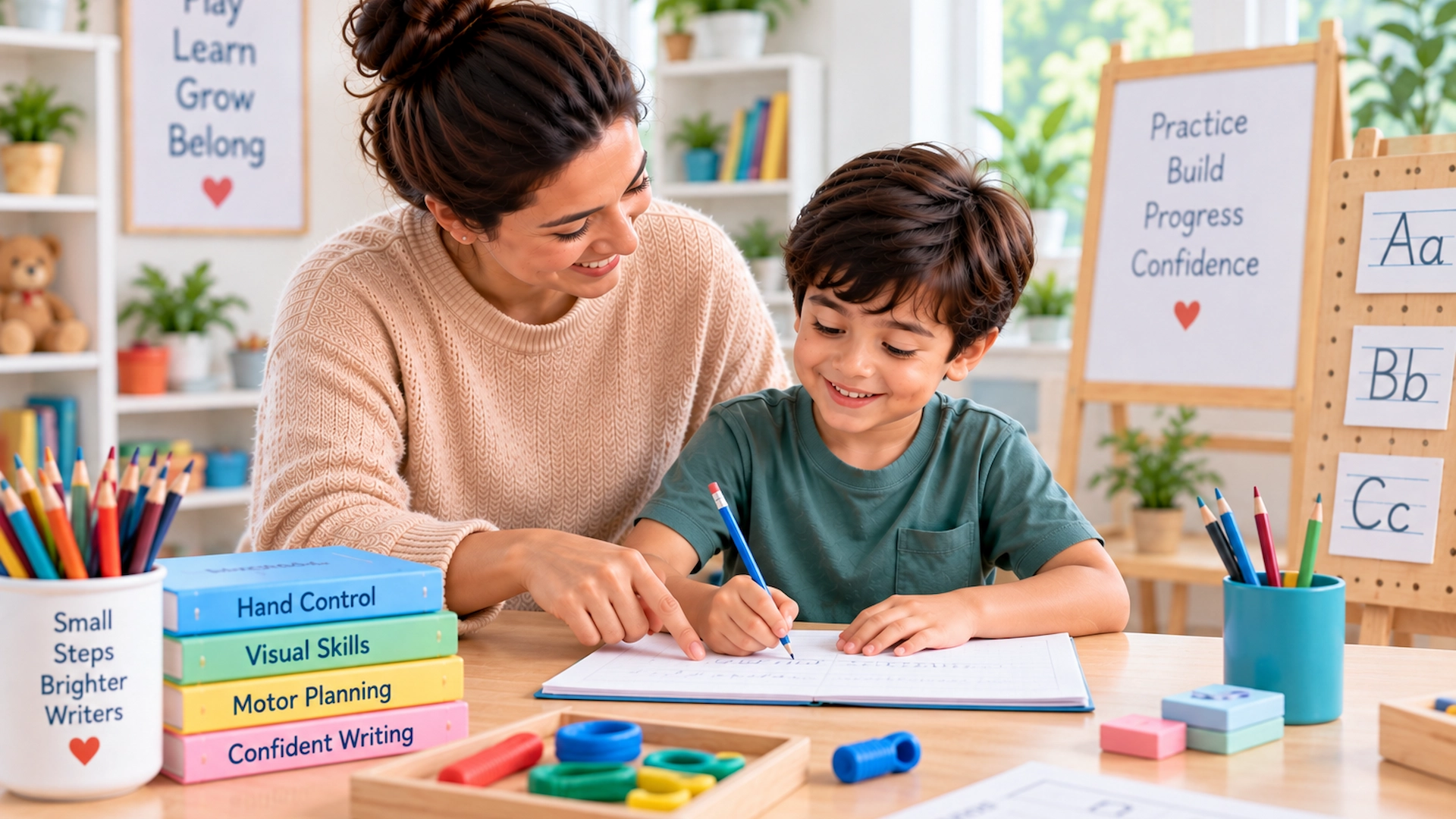
One of the most visible areas where motor development affects school participation is handwriting. Parents may notice that their child:
- Holds the pencil awkwardly
- Presses too hard or too lightly
- Produces very large or very small letters
- Has difficulty staying within lines
- Writes slowly
- Tires quickly
- Avoids writing activities
- Struggles to copy from the board
- Finds longer written assignments difficult
But handwriting is a complex skill. It requires the integration of posture, visual perception, visual-motor skills, hand control, motor planning, attention, and repeated task-specific practice.
Research supports the value of handwriting-focused occupational therapy interventions, although the strength of evidence varies across intervention types and studies. A systematic review found that handwriting interventions for young children could improve targeted skills, while also noting limitations in the quality of the available evidence. Another systematic review found that interventions including adequate handwriting practice were more effective than approaches that relied only on underlying component training without handwriting practice.
This leads to an important principle: If the goal is better handwriting, children generally need meaningful practice with handwriting itself - not only isolated finger exercises. The American Occupational Therapy Association similarly identifies therapeutic handwriting practice as having strong evidence, while cautioning against relying solely on isolated activities aimed at underlying components.
What Activities Can Support Fine Motor Development?
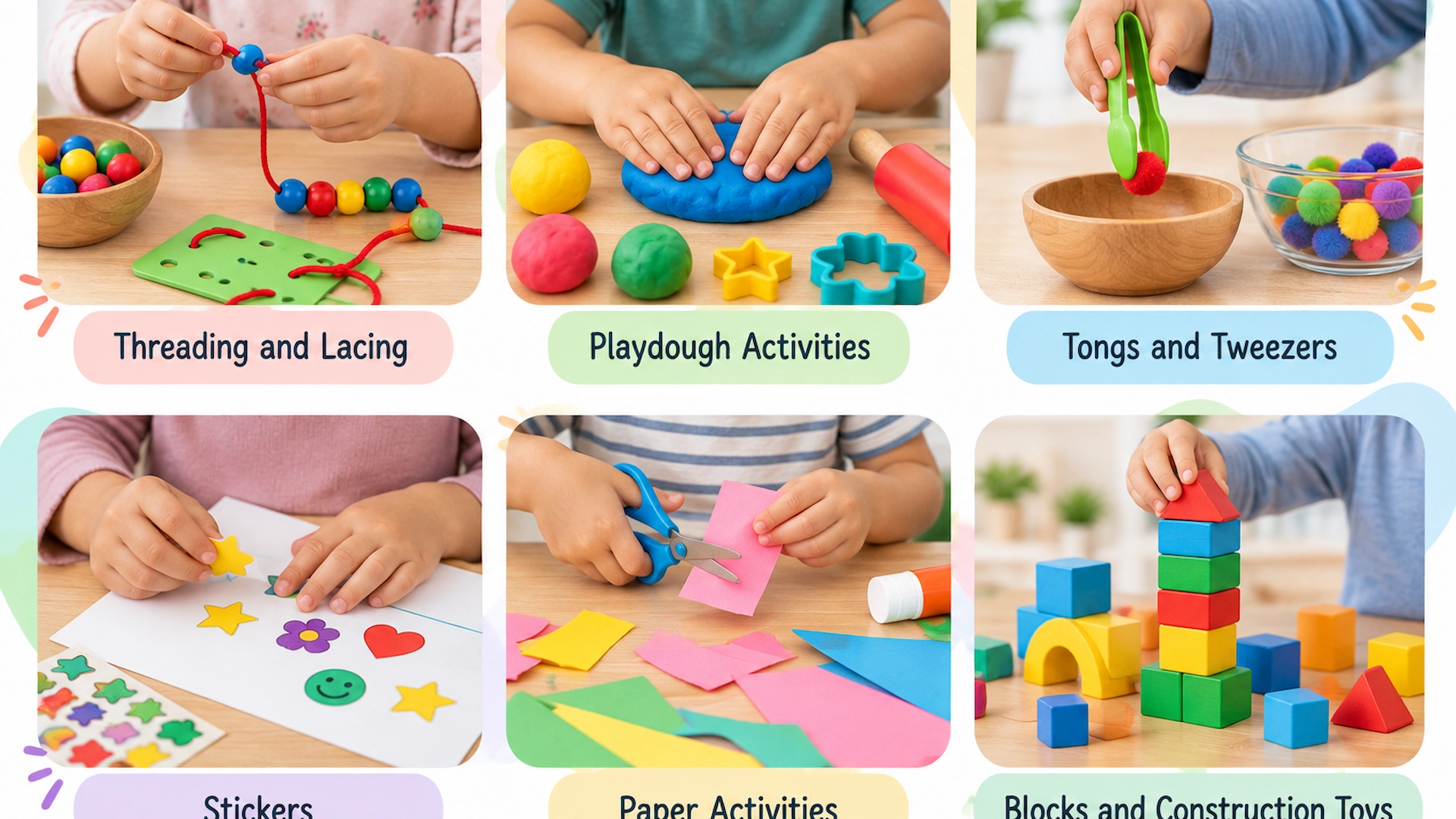
Parents can use these activities to improve the fine motor skills of their children.
Threading and Lacing
Threading beads or lacing cards can encourage visual-motor coordination, bilateral hand use, and controlled finger movements.
Playdough Activities
Rolling, pinching, squeezing, flattening, and shaping play materials can provide opportunities for hand and finger movement.
Tongs and Tweezers
Picking up small objects using tongs can challenge grasp, release, hand strength, and precision.
Stickers
Peeling and placing stickers requires controlled finger movements and visual-motor accuracy.
Paper Activities
Crumpling, tearing, folding, cutting, and pasting paper can provide varied opportunities for hand control.
Blocks and Construction Toys
Building with blocks or construction materials can involve grasp, release, bilateral coordination, spatial planning, and problem-solving.
The important point is that the activity should have a purpose. Occupational therapy is not simply about filling a session with fine motor exercises. The activity should connect to the child's functional goals.
Therapeutic Principles That Make Occupational Therapy Effective
Good motor skill intervention is not simply about making a child practise harder. Four principles are especially important.
Active Engagement
Children learn through actively participating in movement rather than passively receiving it. A child who chooses, explores, reaches, builds, cuts, draws, and manipulates objects is actively learning.
The Right Challenge
Activities should be challenging enough to encourage skill development without becoming so difficult that the child repeatedly fails. The therapist gradually adjusts the task according to the child's abilities.
Feedback
Children learn from feedback. They may receive information from the therapist, their own visual observation, touch, movement, or the result of the task. Over time, children can begin to recognise what adjustments help them succeed.
Repetition and Consistency
Motor learning requires practice. But the quality of practice matters. Repeating a poorly performed movement without adjustment is not necessarily productive. A therapist may modify the task, provide feedback, change the environment, or reduce assistance as the child becomes more capable.
When Should Parents Consider Occupational Therapy?
A child does not need to have a particular diagnosis to benefit from an occupational therapy assessment. Parents may consider professional evaluation when motor difficulties consistently interfere with everyday activities.
For example, you may notice that your child:
- Avoids drawing, colouring, or writing
- Has difficulty using scissors
- Struggles with buttons, zippers, or shoelaces
- Finds feeding themselves difficult
- Frequently drops or struggles to manipulate objects
- Uses one hand for almost everything and finds two-handed tasks difficult
- Becomes tired quickly during handwriting
- Has difficulty with puzzles, blocks, or other age-appropriate fine motor play
- Appears significantly behind expected developmental skills
- Has difficulty participating in classroom activities because of motor demands
One difficulty by itself does not automatically mean that something is wrong. Children develop at different rates. But persistent difficulty that affects participation is worth discussing with a pediatrician, developmental professional, or occupational therapist. Expert Occupational Therapists at Gratus Kids helps you to identify if something’s wrong and will be with you throughout your child’s journey.
Occupational Therapy Is About More Than “Improving Handwriting”
This is perhaps the most important idea for parents to understand. Fine motor development is not an isolated skill. A child's hand skills can influence participation in many occupations.
A stronger progression might look like:
For one child, the meaningful outcome may be writing a paragraph at school. For another, it may be using a spoon independently. For another, it may be buttoning their shirt. And for another, it may simply be being able to participate in play with other children. This is why occupational therapy looks at the child within their real environment rather than focusing only on a single movement.
The Role of Parents, Teachers, and Therapists in Motor Skills Development
Motor development does not happen only inside a therapy room. Children practise skills during breakfast, playtime, school, dressing, drawing, craft activities, and daily routines.
That makes collaboration an important part of pediatric occupational therapy. An occupational therapist may work with parents and caregivers to carry useful strategies into the home. Where appropriate, the therapist may also collaborate with teachers to support classroom participation. For example, instead of having a child practise a skill only during a therapy session, adults can look for natural opportunities to practise the same skill during everyday routines. This can make therapy more functional and meaningful.
What Does a Pediatric Occupational Therapy Assessment Look At?
A comprehensive assessment may consider several areas rather than looking only at fine motor ability. Depending on the child's needs, an occupational therapist may examine:
- Motor skills: hand strength, grasp, coordination, dexterity, bilateral hand use, and motor planning.
- Visual-motor skills: how effectively the child uses visual information to guide movement.
- Posture and stability: how the trunk, shoulders, and arms support hand movements.
- Sensory factors: whether sensory processing appears to influence participation in particular activities.
- Functional performance: how the child manages handwriting, dressing, feeding, play, school tasks, and other daily occupations.
- Environment: whether changes to materials, seating, tools, routines, or task demands could make participation easier.
This broader perspective is important because the same visible difficulty can have different underlying causes in different children.
Occupational Therapy Should Be Functional and Individualised
Research supports occupational therapy interventions for children's motor development, but it also shows why therapy should not be treated as a one-size-fits-all programme.
A systematic review of OT interventions for children aged 0-5 found evidence supporting several intervention approaches, while also noting that evidence quality varies across areas. Research on fine motor interventions in children from birth to six years has also found generally positive effects, with a meta-analysis reporting moderate effects on fine motor, visual-motor, and manual dexterity outcomes across the included programmes.
Similarly, a broader systematic review of pediatric occupational therapy found evidence supporting several activity-level interventions, including handwriting task-specific practice, goal-directed training, family-centred care, coaching, and home programmes. The message is not that every child needs the same intervention. It is that assessment, meaningful goals, appropriate practice, family involvement, and measurable functional outcomes matter.
Helping a Child Build Motor Skills at Home
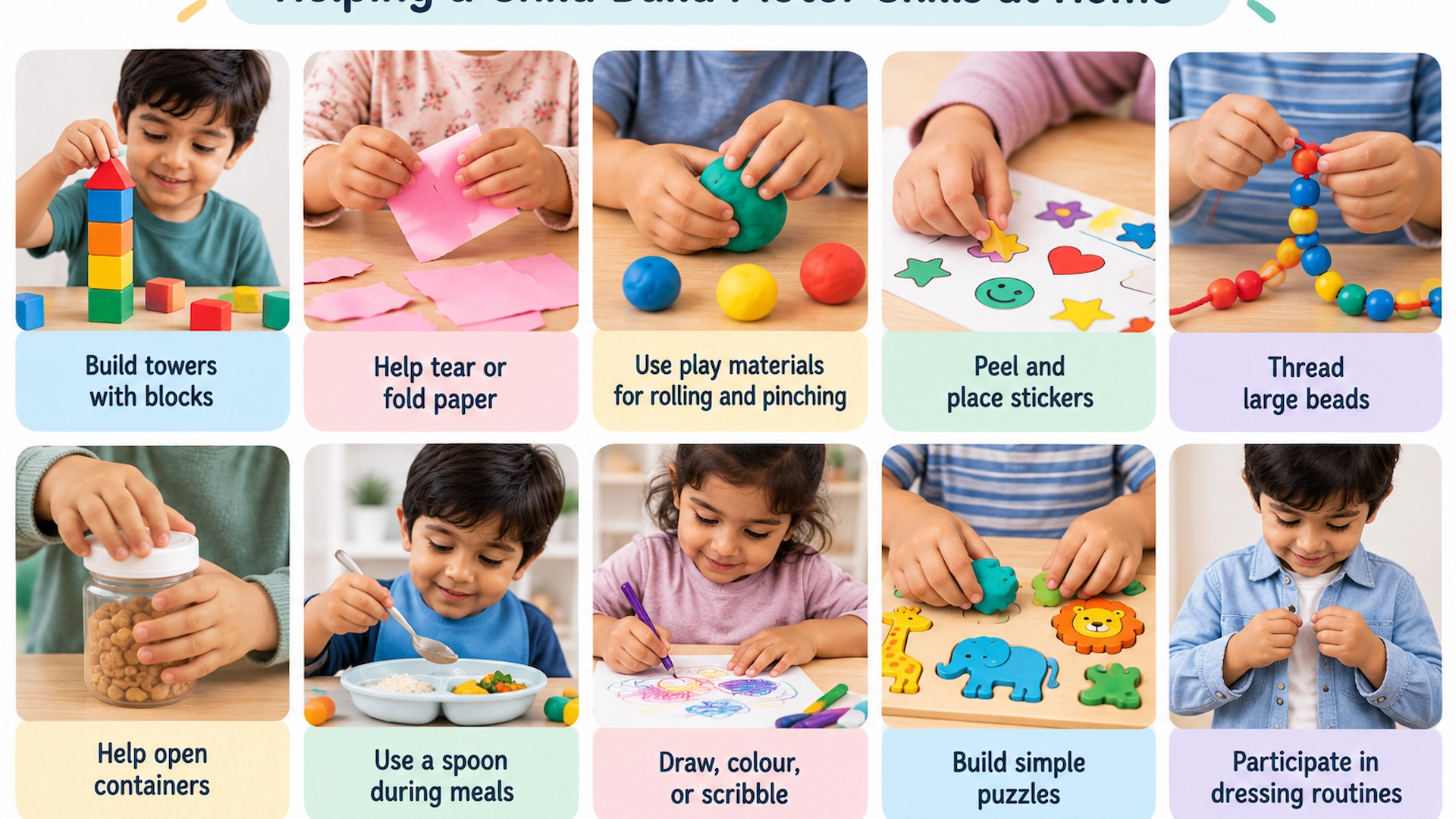
Parents do not need expensive equipment to encourage fine motor development. Everyday routines can provide excellent opportunities.
You can invite your child to:
- Build towers with blocks
- Help tear or fold paper
- Use play materials for rolling and pinching
- Peel and place stickers
- Thread large beads
- Help open containers
- Use a spoon during meals
- Draw, colour, or scribble
- Build simple puzzles
- Participate in dressing routines
The activity should match the child's developmental level and remain enjoyable. Most importantly, avoid turning every activity into a test. Children learn better when they feel successful, involved, and encouraged.
Building Skills That Matter in a Child's Everyday Life
Motor skill development is a gradual journey. A child's first grasp, first scribble, first successful use of a spoon, first tower of blocks, first cut with scissors, and first written letters may seem like separate achievements. In reality, they are connected steps in the development of coordination, motor planning, dexterity, visual-motor integration, and independence.
Occupational Therapy can help identify where a child is finding difficulty and build an individualised pathway toward meaningful participation. The ultimate goal is not simply stronger fingers or neater handwriting. It is a child who can play more freely, participate more confidently, manage everyday activities with greater independence, and engage in learning without motor difficulties becoming a constant barrier.
When therapy connects motor development to the activities that genuinely matter to the child, every small improvement can become part of something much bigger: greater participation and growing independence in everyday life.


Frequently Asked Questions
Clinical answers to common questions about pediatric occupational therapy and motor skill rehabilitation.
No. While handwriting and fine motor coordination are common reasons for referral, occupational therapy addresses all underlying components of a child's daily participation-including postural stability, bilateral integration, motor planning, sensory regulation, and self-care skills like dressing and feeding.
Handwriting is an integrated skill that requires visual-motor coordination, posture, motor planning, and task-specific fluency. Research shows that practice must be functional and task-specific; simply squeezing stress balls or playdough without structured writing practice does not transfer efficiently to classroom performance.
No formal diagnosis is required. Parents can seek an occupational therapy evaluation whenever fine motor, coordination, or motor planning challenges consistently interfere with daily activities such as holding utensils, fastening buttons, drawing, or classroom participation.